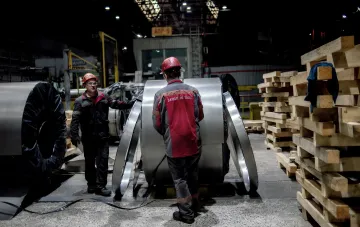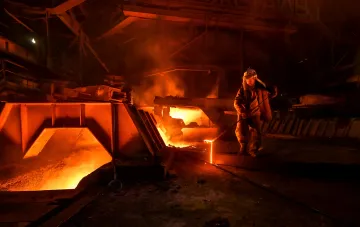
Russian attacks on metallurgical enterprises and the blockade of Black Sea ports have already had a direct and measurable impact on tax revenues to the state budget of Ukraine. According to data disclosed by Metinvest Group and published by RBC-Ukraine, in January–September 2026, the company paid UAH 13 billion in taxes and fees—6% less than in the same period of 2025. For one of the country's largest taxpayers, this decline is an alarming signal: it reflects not temporary fluctuations, but a systemic contraction of production capacities under pressure from military and logistical factors.
Structure of Losses: VAT and Corporate Income Tax Under the Greatest Pressure
The sharpest reduction was recorded in value-added tax (VAT): revenues dropped by 36% to UAH 914 million. Corporate income tax decreased by 26% to UAH 1 billion. These figures indicate that the volumes of sold products and, accordingly, gross value added at the group's enterprises have decreased significantly. Under conditions where some production lines are idle due to infrastructure damage or the threat of repeated strikes, a reduction in the tax base for VAT and profit becomes an inevitable consequence rather than a result of management decisions.
Six Ballistic Missile Attacks in Three Months: Chronicle of Plant Shutdowns
According to the company's assessment, the key factor was direct Russian attacks on production facilities. In September 2026, Kametstal and the joint venture Zaporizhstal were forced to suspend operations following shelling. Between August and October, the two plants survived six attacks involving 27 ballistic missiles. At the same time, as Metinvest emphasizes, this statistics does not include regular drone strikes by Shaheds and guided aerial bombs (KAB), which also damage infrastructure and force personnel to leave work areas. Each production shutdown lasting several days or weeks means an irreplaceable loss of volumes that cannot be "made up" in subsequent months due to the technological cycles of the metallurgical process.
Port Blockade and Rising Cost of Alternative Logistics
In addition to direct physical destruction, Ukraine's metallurgical sector faces a chronic blockade of Black Sea ports, which makes exporting products via traditional routes extremely difficult. Alternative logistics—through the Danube and rail corridors to Poland and Romania—are significantly more expensive and do not always allow Ukrainian steel to remain competitive on external markets. Metinvest Group CEO Yuriy Ryzhenkov noted in a commentary to RBC-Ukraine: "We have found ourselves at a critical point. Metallurgists are losing the opportunity to produce and export steel, and the country risks losing jobs and billions of hryvnias in taxes." According to him, the government must first and foremost work on restoring port logistics and more actively defend the interests of the Ukrainian metallurgical industry in the European Union.
Additional Pressure: EU Quotas, CBAM, and Tariffs
Against the backdrop of military and logistical problems, Ukraine's metallurgists are facing a number of external restrictions. Reduced European Union quotas on imports of Ukrainian steel limit the volumes that can be legally supplied to the largest European market. The CBAM (Carbon Border Adjustment Mechanism) introduces additional financial obligations for exporters, while rising electricity tariffs and domestic railway freight rates increase production costs. The combined effect of these factors creates a heavy burden on the industry's profitability: even those enterprises that formally continue to operate are forced to reduce volumes due to the unprofitability of exports at current prices.
Historical Context: UAH 43.6 Billion in Investments and UAH 82.2 Billion in Taxes Over Four Years
To complete the picture, it is important to compare the current decline with long-term dynamics. Over 2022–2025, Metinvest Group invested UAH 43.6 billion in the development of its enterprises and paid over UAH 82.2 billion in taxes. Since the beginning of the full-scale war, the company has channeled over UAH 10 billion to support Ukraine and its citizens, of which UAH 7.3 billion was transferred to the needs of the Defense Forces under the Steel Front initiative. The group's enterprises have also established the production of frontline supplies, including protective gear and special equipment. Metinvest warns that if production cuts continue under the combined pressure of shelling, logistical blockades, and external restrictions, the drop in tax revenues will affect not only the state budget, but also the budgets of industrial communities, which largely depend on tax deductions from metallurgical enterprises.