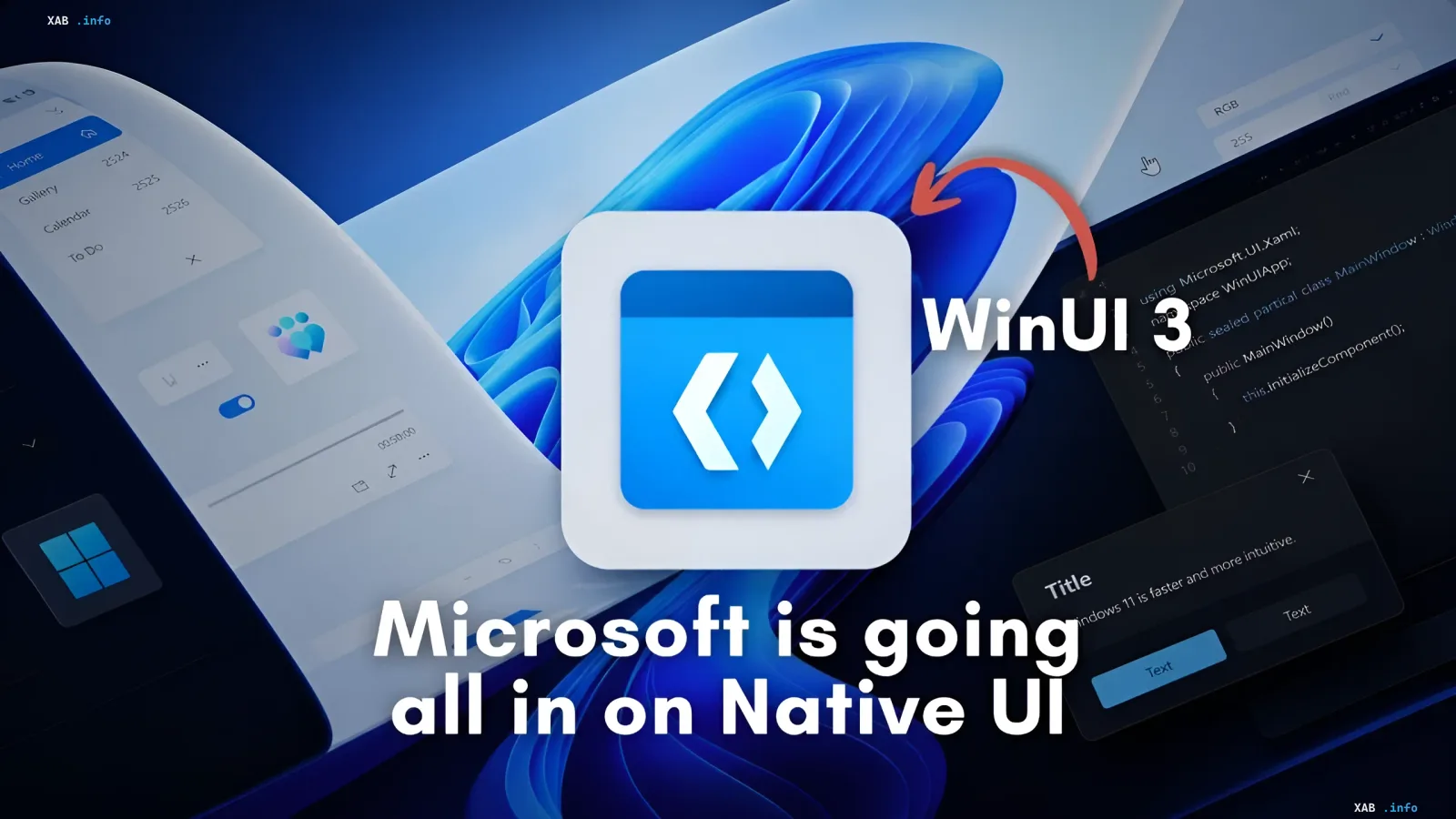
In August 2026, Microsoft takes another decisive step in the transformation of its operating system. The company's strategy has definitively shifted towards abandoning outdated components in favor of the modern WinUI 3 platform. This is not just a cosmetic update, but a fundamental restructuring of the interface architecture, aimed at eliminating the legacy rooted in the Windows 95 era.
Abandoning "patches" in favor of a complete rewrite
For a long time, Windows 11 users have faced a situation where modern design elements coexisted with dialog boxes that have hardly changed in three decades. Microsoft acknowledges that in the past it used a simplified approach: support for the dark theme was simply overlaid on top of old code. This led to visual artifacts and instability. However, the company is now moving to a strategy of complete rewriting. A bright example is the file properties window in File Explorer, which was created from scratch in WinUI 3, rather than receiving a new look through a "wrapper".
March Rogers' strategy and future plans
Microsoft representative March Rogers confirmed that migrating system elements to WinUI 3 is a priority. The plans include updating the file copy dialog, the standard file open window, and even the Start menu, which currently partially uses React Native. The goal is to create a single, consistent platform where all elements behave predictably and work at the same speed. This will eliminate the gap between "old" and "new" in the interface, which annoyed users and reduced the overall impression of the system.
Contradictory data: Beauty vs. Performance
Despite ambitious plans, the transition to WinUI 3 is not without risks. Experts and developers note that the new platform may currently consume significantly more RAM than time-tested Win32 components. Some WinUI 3 elements work slower than their older counterparts, casting doubt on the thesis that the interface will become "lighter". Microsoft will have to prove that visual advantages and unification will not lead to a slowdown of the system on mass-market hardware.
Conclusion: Windows 11 becomes modern
By 2026, the transition process is gaining momentum. Microsoft no longer plans to leave old windows as they are, understanding that this hinders the development of the ecosystem. The transition to WinUI 3 is not just a change of fonts and colors, it is a change in the paradigm of interface development. If the company manages to solve performance issues, Windows 11 will become a truly modern system, free from the ballast of the past.