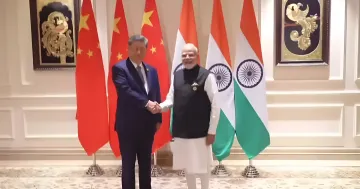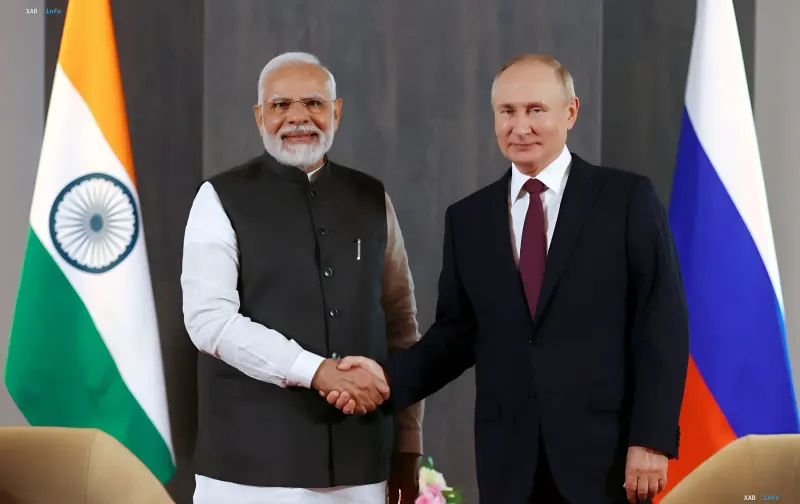
Indian Prime Minister Narendra Modi and Russian President Vladimir Putin held a bilateral meeting in New Delhi on the eve of the two-day BRICS summit, which kicked off on Saturday. Against the backdrop of the two countries' national flags, the leaders shook hands for the cameras before moving on to discuss the agenda. According to India's Foreign Ministry, the main topic of the talks was the situation around Ukraine and the broader question of settling conflicts in the Black Sea region. The meeting continued the line New Delhi has been pursuing since Russia's full-scale invasion in February 2022.
Call for Dialogue and Diplomacy
As reported by India's Foreign Ministry, Modi told Putin that "dialogue and diplomacy are the right way to resolve conflicts," and emphasized India's readiness to support peace efforts. This rhetoric echoes the position the Indian prime minister had voiced earlier: in late August, at a meeting in Kyrgyzstan, he publicly called on Putin to end the fighting right in front of the cameras, stating that "the path from an endless war to its conclusion must be walked." Putin then replied that Russia was "exactly on that path." Thus, the New Delhi meeting became yet another episode of public pressure by New Delhi on Moscow over the Ukrainian issue.
New Delhi's Pragmatic Stance and Economic Ties
India remains one of the largest buyers of Russian oil and grain, and it is economic interests that largely shape its diplomatic course. The country has already felt the consequences of the Black Sea crisis: Indian sailors have become victims of drone attacks, and shipping in the region has been disrupted. New Delhi consistently adheres to a pragmatic line, maintaining close ties with both Western partners and Moscow, which allows it to occupy a mediating, though not morally neutral, position. Against this backdrop, calls for dialogue sound like an attempt to preserve balance while simultaneously reducing risks to its own trade and citizens.
Contradictory Data
Despite official confirmation of the meeting and the discussion of the Ukraine topic, there are inconsistencies in the available sources. First, Indian media did not publish video of Modi's statements, so the exact degree of directness of his words in New Delhi remains unconfirmed; Putin's foreign policy advisor Yuri Ushakov merely noted that the Ukraine topic had been discussed. Second, the Indian Foreign Ministry's wording refers to conflicts "in the Black Sea region," not directly to the war in Ukraine, creating a difference in emphasis between the Indian and Russian readings of the agenda. Third, Moscow's positions on peace appear contradictory: on September 10, Peskov stated that Russia was not considering an "energy ceasefire," calling energy Ukraine's "weak point," while at the same time the Kremlin emphasized its readiness for a peaceful settlement, shifting responsibility for the further negotiation process onto Kyiv. These discrepancies between words about readiness for peace and the refusal of specific concessions require cautious interpretation.
Context: BRICS Summit and Regional Agenda
The BRICS summit in New Delhi focuses on trade, technology, and regional conflicts; among the leaders present is Chinese President Xi Jinping. The grouping, which began as a bloc of Brazil, Russia, India, China, and South Africa, has been expanded to include Iran, Egypt, Ethiopia, the UAE, and Indonesia, making it a platform for multipolar diplomacy. In such a configuration, India's call for dialogue sounds not as an isolated statement but as part of a broader attempt to shape a common discourse on conflict resolution within BRICS. For Moscow, this meeting is an opportunity to confirm its status as a key partner in the Global South; for New Delhi, it is a chance to strengthen its role as a mediator while maintaining economic and strategic ties with both sides of the conflict.