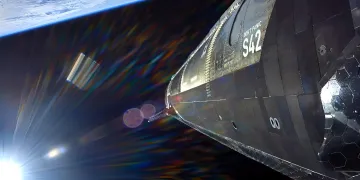
Over the last decade, the pace of launching spacecraft into orbit has accelerated dramatically. Massive satellite internet projects, primarily Starlink, have led to such a buildup of hardware in low Earth orbit (LEO) that the number of objects in the sky over a typical mid-latitude city has begun to exceed the number of stars a human can distinguish with the naked eye. This is the conclusion reached by researchers at Accu Components, who conducted an analysis of active satellite trajectories. Their work documents a turning point: artificial objects are now systematically "crowding out" the stellar background in urban latitudes.
How it was calculated: 15,833 satellites and 710 over the city
For their calculations, Accu Components specialists used data on 15,833 active satellites orbiting Earth at an altitude of less than 2,000 kilometers. The trajectories were obtained from the publicly accessible CelesTrak catalog, maintained by the U.S. Space Force, and calculated based on snapshots from October 12 and 18 of this year. According to the simulation, with a perfectly open horizon, there are 710 satellites in the sky over a typical city in the UK at any given moment at night. This specific figure is the key finding: it exceeds the number of stars visible to the naked eye under urban light pollution conditions.
Geography of the cluster: why mid-latitudes
High satellite density is not characteristic of the entire planet, but primarily of most of Europe, the United States, and other regions in mid-latitudes — especially the band between 40 and 50 degrees north or south latitude. The reason lies in orbital geometry: most Starlink satellites travel along trajectories with an inclination of about 53 degrees to the equator, causing them to concentrate specifically in mid-latitudes. Global indicators, according to the researchers, are approximate and based on calculations using a grid covering the entire planet over a 24-hour period. The fewest number of satellites are observed near the equator, where the count is around 490.
What is actually visible to the naked eye
It is important to understand that not all 710 satellites are visible without optical aids. A satellite becomes visible when it is illuminated by the sun while Earth's surface is in darkness. In the first hour after sunset over a British city, about 300 "glowing" satellites are visible; by midnight, the number of visible satellites drops to 20, and before dawn, it grows again to 300. On average, 105 out of 710 satellites reflect sunlight while flying over Earth. For comparison, according to the OwnStarMap project, deep at night over major metropolises like London or New York, due to intense light pollution, only a few dozen stars are visible to the naked eye; in small towns, a few hundred are visible, while thousands of celestial bodies are only visible far from civilization, in remote rural areas or mountainous regions.
Prospects and risks for astronomy
The situation, according to experts, will only worsen. Satellite companies plan to launch hundreds of thousands, and possibly millions, of satellites into orbit over the coming decades. In such a scenario, the number of passing satellites could significantly exceed the number of visible stars over any city on Earth. Astronomers fear this will have a direct impact on the ability to observe celestial bodies and the pace of space exploration. Thus, the Accu Components study documents not just a statistical fact, but the beginning of a structural change in the night sky to which both science and casual observers will have to adapt.