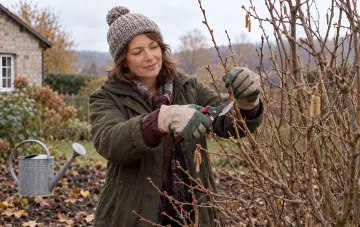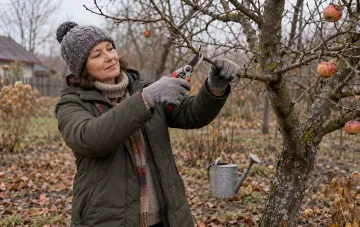
November is not the time to reach for the pruning shears and hurriedly trim a mulberry tree if it still holds its leaves. According to the Royal Horticultural Society (RHS), the optimal window for pruning mulberry trees opens after the leaves have fully fallen in autumn and closes by mid-winter. During this period, sap movement through trunks and branches is minimal, meaning the cut dries quickly and does not become a "wound" through which the tree loses resources. In late winter and spring, when sap flow resumes, the same cuts begin to "weep" sap, weakening the branch and creating an entry point for pathogens. The conclusion is simple: if there are still yellow leaves on the branches in November, put the shears away and return to work once the canopy is bare.
How much to prune: moderation is more important than radicalism
An adult mulberry, unlike an apple or cherry tree, does not require annual formative or rejuvenation pruning. It is enough to inspect the crown and remove branches that are tangled, rubbing against each other, or hindering normal growth. Woodland Trust experts emphasize that heavy pruning of an old tree triggers vigorous growth of new shoots from dormant buds, which will not mature before the frost and will freeze the following winter. In other words, the more aggressively you prune an adult tree, the more problems you will have next season. The tool must be sharp and clean; according to University of Minnesota recommendations, the cut should be made just outside the branch collar, the small swelling at the base of the branch. Do not cut the branch flush with the trunk and do not leave long stubs: both disrupt the natural healing process. Work should be done in dry weather; if hard frosts are forecast, it is better to postpone. Large branches on tall trees are safer to remove with the help of a professional and safety equipment.
Roots and trunk: what to do with young saplings
An adult mulberry of a winter-hardy variety usually withstands frost without any cover. It is a different story for first- and second-year saplings. Research by the Institute of Horticulture of the NAAS of Ukraine has shown that varieties like 'Large-fruited Black' and 'Istanbul Pink' tolerate winter well from the age of two, while one-year-old plants suffer from frost-bitten tips and bark damage. Therefore, it is young trees that need additional care. The root zone should be mulched with organic material to a depth of 7–8 cm, spreading it in a wide circle while leaving space around the trunk itself. Do not pile mulch directly onto the root collar: constant moisture in this area leads to bark rot and decay. Mulch performs a double function: it retains moisture in the soil and smooths out sharp temperature fluctuations in the ground, protecting the roots from the cycle of thaws and freezes.
Watering and fertilizing: when they are appropriate and when they are harmful
If the autumn has been rainy, additional watering for the mulberry is unnecessary. However, after a prolonged drought, a young tree may need moisture even after dropping its leaves. According to the University of Illinois, autumn watering is appropriate under three conditions: the soil has actually dried out, the tree is under five years old, and watering is done slowly so that the water penetrates the root zone rather than forming a puddle near the trunk. An adult mulberry that has long been established on the plot usually only needs extra water in years of anomalous drought. As for fertilizer, nitrogen fertilizers should categorically not be applied in late autumn: they stimulate the growth of young shoots that will not have time to lignify before the first frost and will freeze. Phosphorus-potassium complexes are permissible, but they are not mandatory for a healthy adult tree.
Sun and rodent protection: trunk wrapping
In winter, young trees are damaged not only by frost but also by sharp temperature changes. On a clear winter day, the bark on the sunny side heats up and cools down rapidly at night; as a result, cracks and sunscald appear on the trunk. University of Wisconsin experts recommend protecting young mulberries with a light-colored garden wrap, applied from the bottom of the trunk to the first major branches, with each turn slightly overlapping the previous one. The light material reflects sunlight and reduces daytime heating of the bark. Additionally, a mesh or guard is installed around the trunk to protect against hares and rodents, which actively damage bark during hungry winters. The temporary wrap is removed in the spring, after the last frosts, so as not to disrupt natural ventilation and avoid triggering fungal diseases under the dense layer of material.
What not to do: typical mistakes before cold weather
Even a frost-resistant mulberry is easy to damage with improper care. The main mistakes gardeners make in November are hasty pruning before leaf fall, applying nitrogen fertilizers "for the road," mulching by covering the root collar, and completely ignoring young saplings. If a mulberry has been growing on the plot for many years and consistently survives local winters, an annual inspection of the crown, monitoring of soil moisture, and moderate sanitary pruning after leaf fall is sufficient. Everything else—mulch, wrapping, rodent protection—primarily concerns trees under three years old that have not yet developed stable winter hardiness.