November marks the final stage of preparing fruit trees for winter dormancy. After harvesting, apple trees gradually enter a dormant phase; however, incorrect or insufficient care during this period can lead to damage to the bark, roots, and branches. Agronomic recommendations summarized in the Styler report, referencing data from the Universities of Minnesota, Maryland, Colorado, and Iowa, allow gardeners to clearly determine which tasks must be completed before sustained freezing weather arrives and which are better left for spring.
Cleaning the Tree Ring: The First Step Against Disease
Immediately after the harvest concludes, the area around the trees should be cleared of fallen apples, weeds, and leaves, especially those showing signs of disease. Special attention is given to apple trees that suffered from scab during the season: the pathogen responsible for this fungal disease can overwinter in fallen foliage and spread to young shoots and fruit in the spring. As specialists from the University of Minnesota explain, accelerated decomposition of infected leaves helps reduce the number of fungal spores surviving into the next season. Fallen leaves can be collected for composting or shredded with a lawnmower; when composting infected debris, it is important to ensure conditions under which the plant material completely breaks down.
Watering: How Much and When to Apply Water
The need for autumn watering depends on weather conditions. If November is rainy and the soil remains moist, additional water is not required for the trees. According to recommendations from the University of Maryland, soil moisture should be checked at a depth of about 15 cm before watering — simply make a small, careful indentation with a garden trowel and evaluate the soil by touch. If the soil is dry and there have been no prolonged rains, the apple tree must be watered. Water should be applied slowly so that it penetrates deeply rather than running off the surface. The key principle of autumn watering is not the frequency of watering, but ensuring adequate soil moisture before freezing begins.
Mulching: Protecting Roots Without Harming the Bark
Mulching helps retain soil moisture and buffers extreme temperature fluctuations around the root system. Specialists from Colorado State University recommend using organic materials such as wood chips and shredded bark. At the same time, mulch should never be piled in a high mound against the trunk: constant moisture accumulation damages the bark, and an excessively thick layer prevents water and air from reaching the soil. If the apple tree is already mulched, it is sufficient to check the thickness of the layer and add material if necessary.
Protecting Young Trees from Frost Cracks
Young apple trees are especially vulnerable to winter damage. The danger comes not only from severe frosts but also from sharp temperature fluctuations: on sunny winter days, the trunk warms up and then cools rapidly after sunset, leading to the formation of frost cracks in the bark. November recommendations from the University of Minnesota advise protecting young trees with light-colored guards that reflect sunlight. Dark, dense wrapping materials are not recommended because they heat up intensely in the sun and exacerbate temperature swings. Mature, winter-hardy apple trees generally do not require covering the entire canopy, but trunk protection against rodents and animals may be needed for trees of any age.
Pruning: What Is Acceptable and What Is Not in November
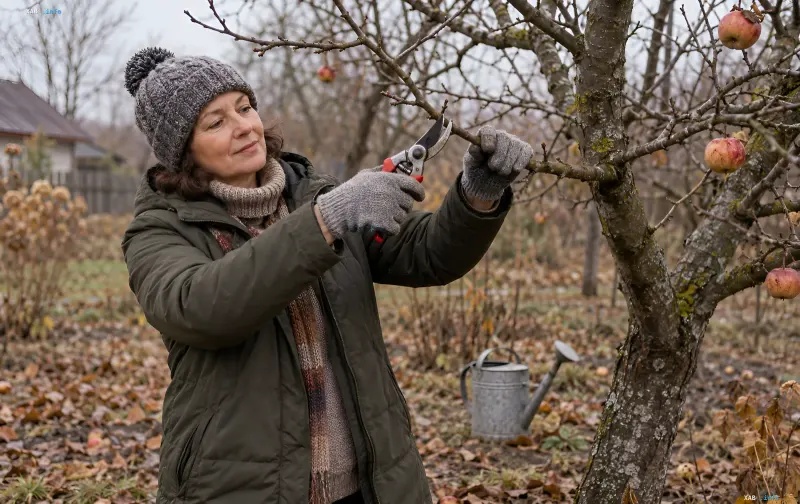
November is not always suitable for pruning apple trees, especially in regions with freezing winters. According to recommendations from Iowa State University, major formative pruning is best performed in late winter or early spring while the tree is dormant. Early winter pruning increases the risk of cold damage to the wood. In November, it is acceptable to inspect the canopy and mark branches slated for removal, as well as to cut away broken or hazardous branches. Large-scale canopy shaping should be postponed until late winter when the risk of severe frost has passed. Young apple trees require special caution: excessive removal of shoots can delay the onset of fruiting.
Fertilization: When Nutrients Are Needed and When They Are Harmful
Not every apple tree needs autumn fertilization. If the tree grew well during the season, had healthy leaves, and fruited normally, additional fertilizers may be unnecessary. Ask Extension specialists explain that young trees growing normally do not always require fertilizer — nutrient levels in the soil may be sufficient. Fertilization should be planned based on the tree's condition and soil test results. Nitrogen fertilizers at the end of the season require special attention: an excess of nitrogen stimulates new growth that will not have time to harden off before frost. If the apple tree grew poorly during the season, had small or yellowed leaves, the cause should be investigated — this may indicate not only a nutrient deficiency but also problems with the root system or drainage.