When steady cold weather arrives, caring for the garden does not end with the harvest: it is important to prepare the soil itself, where plants will remain until spring. Mulching — covering the soil surface with a layer of organic or inorganic materials — helps protect roots from freezing, smooths out temperature fluctuations, suppresses weeds, and preserves soil structure. According to recommendations from the Royal Horticultural Society (RHS), organic mulch further improves soil structure and creates better conditions for soil organisms. However, there are two important limitations: mulch should not be applied directly against plant stems, and materials that do not allow water to pass through well should be avoided.
Straw — A Simple and Effective Cover for Winter Crops
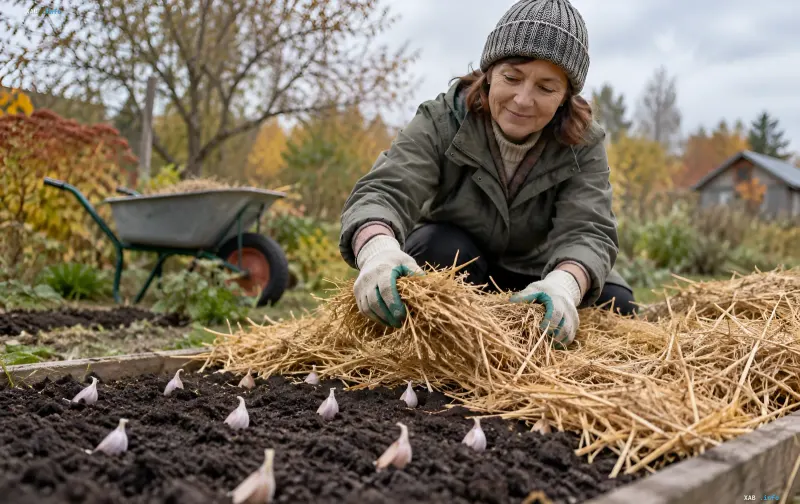
Straw remains one of the most convenient materials for winter covering of beds: it retains air well, protects the ground from sharp temperature swings, and decomposes gradually. It is especially useful for winter garlic. Specialists from the University of Minnesota recommend covering such beds with a 7–10 cm layer of straw or shredded leaves — this reduces soil temperature fluctuations and protects plants from frost. In spring, the cover can simply be pushed aside so young sprouts can easily emerge. The key condition is to use clean straw without weed seeds: hay is less suitable for this purpose because it may contain seeds that will sprout right in the bed in spring.
Fallen Leaves — Accessible Protection for Perennials and Bulbs
Fallen leaves are one of the most accessible ways to protect perennial flowers and garden beds. Dry leaves, shredded by a garden chipper or mixed with other organic matter, are best: such material keeps heat near the roots, protects the ground from drying out, and gradually turns into organic matter that improves soil structure. For flower beds, a layer of shredded leaves about 8–12 cm thick is sufficient. If the leaves are whole, they should not be applied in too thick a layer — under moisture, they can mat down, preventing air and water access. Specialists from the University of New Hampshire specifically recommend leaves for the winter protection of perennials and spring bulbous flowers.
Compost and Wood Bark — For Those Preparing the Soil for Next Season
If the goal is not just to protect beds from frost but also to prepare the soil for the next season, it is wiser to use mature compost. It gradually enriches the soil with organic matter, improves its structure, and helps retain moisture. Compost can be spread over vegetable beds, flower gardens, and areas where new crops are planned for spring. RHS specialists advise applying organic materials in a layer of about 5–7.5 cm; the compost must be well-matured, without fresh plant residue or unpleasant odors. It is not necessary to dig it into the ground — it is enough to distribute it evenly over the surface, allowing soil organisms the opportunity to gradually incorporate the organic matter into the soil structure.
For decorative flower beds, areas around shrubs, and perennials, shredded bark and wood chips are well-suited. They decompose slowly, suppress weeds, and protect the surface from temperature fluctuations, and most importantly, they are durable: unlike leaves or straw, bark does not need to be updated often. However, fresh wood chips should not be incorporated deep into the soil: during their decomposition, microorganisms consume available nitrogen, and plants may temporarily lack it. It is better to leave chips right on the surface as mulch. Peat is also used for structure improvement and moisture retention, but as a standalone winter cover, it is not always optimal: its properties change when wet and compacted, and the protective effect depends on humidity and layer thickness. For most flower and vegetable beds, compost, dry leaves, or straw are more practical.
The Main Mistake — Covering Plants Too Early
One of the most common mistakes is covering garden beds too early, when the ground is still warm and the weather remains relatively comfortable. Under a thick layer of mulch in such conditions, excessive moisture can be trapped, and plants may continue to grow instead of entering dormancy. The University of Minnesota emphasizes the importance of adhering to timing for perennial protection, and the RHS advises applying mulch to moist but not yet frozen soil. Even a quality material can cause harm if applied at the wrong time or in the incorrect amount: mulching only works if the layer thickness, material purity, and timing corresponding to the actual arrival of cold weather are observed.