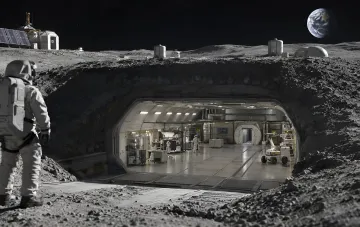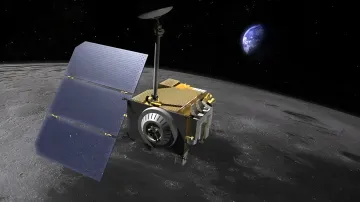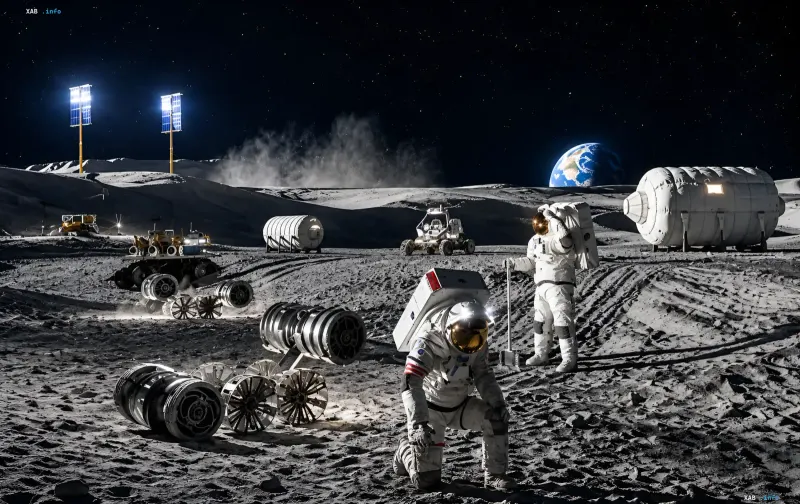
The U.S. National Aeronautics and Space Administration (NASA) has announced a strategic review of its lunar program: instead of a series of short-term expeditions, the agency is aiming for a permanent human presence on the surface of Earth's satellite by 2032. A key element of the new architecture is the Ignition initiative, launched eight months ago, which involves abandoning the construction of the Lunar Gateway orbital station in favor of direct missions with astronaut landings on the surface. The program is phased: the first stage entails a systematic approach to accelerate missions and deploy robotic reconnaissance, while the third involves expanding infrastructure into a fully-fledged permanent Moon base.
From Orbital Station to Direct Landing
The decision to change the paradigm means that astronauts will work directly on the lunar surface rather than in an orbital module. This requires a fundamentally different approach to logistics, energy supply, and life support. To meet tight deadlines, NASA is relying on partnerships with leading private companies: Blue Origin, SpaceX, Northrop Grumman, Lockheed Martin, Intuitive Machines, Firefly Aerospace, Voyager Technologies, and ispace-US. Each is responsible for its own segment—from landing modules to communication systems and heavy logistics.
Multi-Billion Dollar CLPS Contracts
The central element of the commercial component of the program is the CLPS 2 contract—a ten-year agreement worth $10 billion providing for the management, construction, and operation of lunar landing modules. In addition, the original CLPS 1.0 contract has been expanded from $2.6 billion to $4.2 billion. Together, these two agreements form the financial framework upon which lunar infrastructure will be built over the coming decades.
Promise Nuclear Rover for the South Pole
To explore the Moon's surface, the agency is developing the Promise (Polar Rover for Observation, Mapping and In-Situ Exploration) apparatus—a nuclear-powered rover capable of operating during the two-week lunar night and penetrating permanently shadowed deep craters, where scientific models suggest water ice may be stored. The device will be equipped with a drill to extract samples up to one meter deep, as well as spectrometers and a suite of sensors. Blue Origin has received $94 million to implement this mission, with the possibility of an additional $140 million bonus for successfully delivering the rover to the Moon's South Pole.
Energy and Communication for a Monthly Base
Providing the permanent base with electricity is one of the main engineering challenges. Companies such as Honeybee Robotics, Blue Origin, and Yank Technologies are developing solar panels, battery systems, and wireless communication channels. In particular, work is underway on compact towers that combine the functions of a solar power station and communication equipment in a single structure. A separate promising direction is the delivery of heavy cargo from Earth to lunar orbit: Blue Origin, Arrow Science and Technology, and Impulse Space are creating specialized transport orbital vehicles for this purpose.
Context and Outlook
The transition from the Lunar Gateway concept to direct surface missions reflects a broader shift in U.S. lunar policy: the emphasis is moving from orbital infrastructure to ground-based presence using local resources. The Moon's South Pole was chosen as the priority landing zone due to the presence of shadowed craters with potential ice reserves. Implementing the plan by 2032 will require the seamless work of dozens of commercial contractors and the successful debugging of new technologies—from low-power nuclear reactors to wireless power transmission in a vacuum.