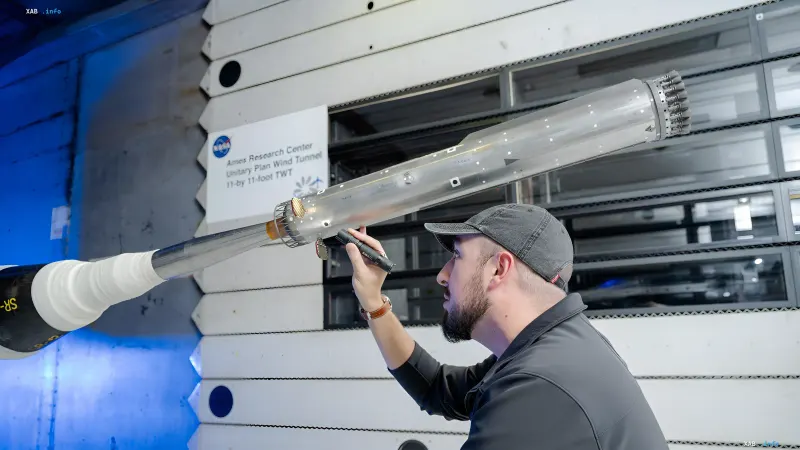
NASA and SpaceX employees have completed a new phase of testing for the Super Heavy booster, version 3. The work took place in the wind tunnels of the Ames Research Center in California. These tests became a key link in the preparation for the Artemis III program and are aimed at accurately studying the loads that the first stage of the Starship rocket experiences when returning to Earth's atmosphere.
Data Accuracy for Atmospheric Re-entry
The data obtained during the experiments is crucial for engineers. It will be used to refine the flight control system and to accurately calculate the loads on the rocket's structure. Without these calculations, it is impossible to guarantee the safety and successful landing of the reusable stage.
The tests were conducted on a high-precision Super Heavy model at a scale of 1.2%. The uniqueness of the methodology was that the testing took place simultaneously in two different wind tunnels:
- In the transonic tunnel, the model was exposed to airflows with speeds ranging from 0.2 to 1.4 Mach.
- In the supersonic tunnel, the speed range was from 1.55 to 2.5 Mach.
Engineers recorded not only the constant aerodynamic forces arising from the flow around the body but also unsteady loads. Special attention was paid to turbulent flows and vibrations, which can critically affect the stability of the rocket at the moment of return.
Structural Changes to Super Heavy Version 3
The need to conduct a new series of tests was dictated by significant changes in the booster's design. Version 3 received a number of important upgrades that directly affect aerodynamic characteristics:
- Installation of new Raptor 3 engines.
- Modification of the engine compartment design, eliminating the use of a common heat shield.
- Integration of the hot stage separation system.
- Replacement of four grid fins with three, each of which has been increased in size by 50%.
All these innovations require a revision of aerodynamic calculations before the start of full-scale flight tests.
SLS Experience Serving the Artemis Program
NASA emphasizes that the methodology of such research has already proven its effectiveness. Previously, similar tests helped upgrade the super-heavy SLS (Space Launch System) rocket. As a result, aerodynamic strakes appeared on it, which will be used during the Artemis II mission.
Currently, similar work is being carried out for Super Heavy Version 3. This modification is intended to become the basis of the Starship Human Landing System (HLS). It is on this system that astronauts are planned to land on the surface of the Moon as part of the Artemis III mission, scheduled for 2027, as well as the subsequent manned lunar expedition in 2028.