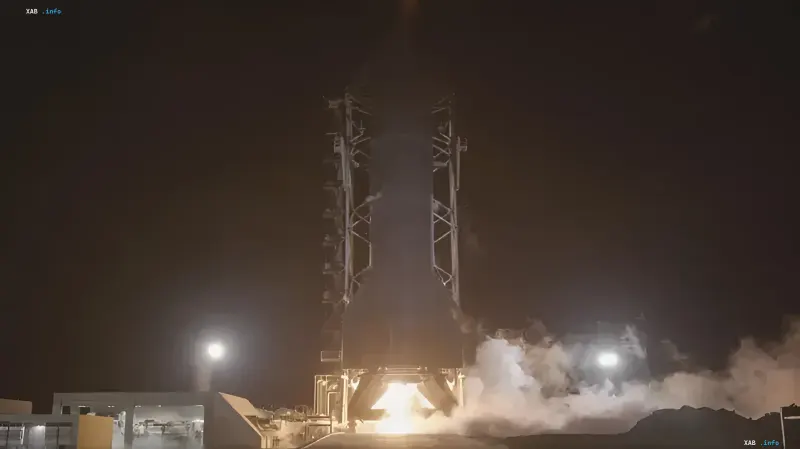
SpaceX has completed another stage of preparation for the 14th test flight of the Starship rocket system: at a pad near the Starbase complex in South Texas, engineers conducted static fire tests of the upper-stage vehicle's engines — the Ship 41 prototype. First, one of the six Raptor 3 engines was fired to simulate its operation during the deorbit maneuver, and then all six of the vehicle's engines were ignited simultaneously for 60 seconds. According to the company, such checks are a mandatory stage before flight: they confirm the proper functioning of the propulsion systems and the vehicle's readiness to generate the required thrust across all segments of the trajectory.
What Ship 41 is and why these tests are needed
The Ship 41 prototype is the upper stage of the Starship rocket system, version V3, the most advanced modification of the system. The vehicle is equipped with three atmospheric and three vacuum Raptor 3 engines, optimized for operation outside the dense layers of the atmosphere. During the fire tests, not only engine ignition was checked, but also the stability of the fuel system, the operation of the control automation, and the vehicle's ability to generate the required thrust throughout the entire trajectory. It is precisely this set of characteristics that determines whether Starship will be able to perform the tasks assigned to it in flight.
Progress of the V3 platform and its characteristics
In previous flight tests, the Starship V3 platform has already demonstrated significant progress: the system approached orbital altitudes, performed complex maneuvers, including a Raptor engine relight in space, and the upper stage successfully carried out a controlled descent and splashdown. The third version of the system is about 124 meters tall and is designed for a significantly larger payload compared to early Starship variants. In the future, SpaceX plans to use this rocket to deploy large satellite constellations, deliver cargo to the Moon as part of the Artemis program, and for subsequent interplanetary missions.
What lies ahead before and after the 14th flight
The first orbital flight of Starship, scheduled for late August or early September, will be a key test of the fully reusable super-heavy rocket architecture. To move toward practical operation, SpaceX still needs to confirm the reliability of orbital operations, the technology for refueling vehicles in orbit, and the reuse of both stages — the Super Heavy booster and the Ship vehicle. In the coming days, the company will conduct static fire tests of the 33 Raptor 3 engines of the Super Heavy booster, after which it will be able to proceed to the final assembly of the rocket ahead of the 14th test flight.
Contradictory data
There is a notable discrepancy between the public statements and the actual preparation scenario, which is worth taking into account. On the one hand, Elon Musk and SpaceX have for years painted a grand picture: the 14th flight was positioned as the first orbital insertion of a fully reusable system into Earth orbit, while previous launches were presented as steps toward orbital altitudes with controlled splashdowns. On the other hand, the preparation text itself directly states that the upcoming flight "will not be as Elon Musk previously promised," meaning the actual scenario and set of tasks for the 14th launch no longer match the initial public promises. Moreover, the terminology of previous flights ("approached orbital altitudes," "controlled descent and splashdown") is not equivalent to a full orbital flight with insertion into a stable orbit, which may create a false impression in the reader's mind that orbit was achieved earlier. Both versions — the ambitious promises and the restrained actual plan — are presented above without any attempt to "smooth them over."