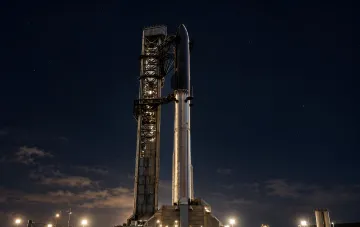
For the first time in the history of space exploration, SpaceX has carried out a full rescue and recovery operation for the upper stage of a Starship rocket from open ocean waters. The Ship 40 prototype, which completed its 13th test flight, splashed down in the Indian Ocean on 24 July 2026 near Australia's Christmas Island and remained on the water's surface for about 24 days before SpaceX engineers began a detailed inspection and preparation for transport. According to BBC, the rescue of the upper stage took three weeks of intensive work, and satellite imagery captured the entire recovery operation.
What the photos show: a 50-meter damaged but intact ship
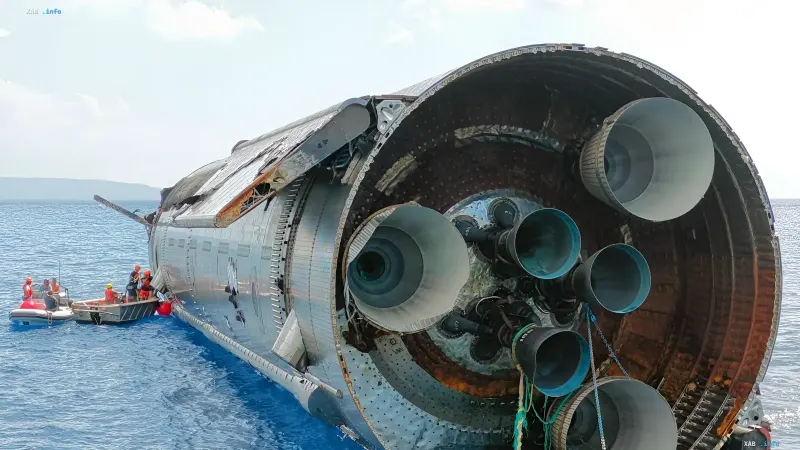
The published images, taken by photographer Svyatoslav Shanygin, show the 50-meter spacecraft drifting in the calm waters of the Indian Ocean. In close-up, the Raptor engines are visible — several nozzles of different diameters, some of them covered in characteristic corrosion and a film of seawater. Damaged sections of the hexagonal-pattern heat shield bear witness to the enormous loads the structure endured during atmospheric reentry. Despite exposure to salt water and extreme temperatures, the ship's hull retained its integrity, a key result for SpaceX engineers. Small boats with crew in orange life vests are visible on the water next to the giant vehicle, clearly illustrating the scale of the structure.
Engineering inspection and the value of the data obtained
At present, a team of SpaceX engineers has arrived at the splashdown site to carry out a detailed inspection of all the ship's systems. Although the likelihood of relaunching this particular prototype is assessed as extremely low due to its prolonged exposure to salt water and inevitable corrosion of internal systems, the practical data obtained during the operation is of enormous value to the company. Particular attention is being paid to information on atmospheric pressure under real flight conditions and the condition of the heat shield after landing. These parameters will be decisive in designing next-generation spacecraft and ensuring the safety of future missions.
Elon Musk's plans: intercepting Starship with the launch tower
SpaceX head Elon Musk personally shared new photos of the rescue process on social media and spoke about the company's near-term plans. According to him, within the next few months SpaceX intends to intercept the returning Starship in mid-air using a special launch tower — the so-called "Mechazilla." Implementing this technology will allow the spacecraft components to be recovered quickly without the need for an ocean splashdown, significantly reducing the time between flights and lowering maintenance costs.
Prospects for a repeat flight and economic efficiency
According to forecasts by specialists and industry analysts, the first repeat flight of Starship based on a restored or new prototype could take place at the end of 2026 or in early 2027. The data obtained during the 13th test flight and the subsequent rescue operation will be a decisive factor in ensuring both the safety and the economic efficiency of future spaceflights. The successful recovery of the ship from the ocean confirms that SpaceX has the necessary resources and competencies to work with the largest crewed and uncrewed vehicles in the history of spaceflight.
Contradictory data
Open sources show a slight discrepancy in the chronology of the operation. The base text on ixbt.com states that the ship was "delivered whole from the ocean waters to the shore," whereas the published photos and BBC data indicate that at the time of filming the vehicle was still in the water and being inspected while afloat. BBC, in turn, describes the operation as the "rescue" of the upper stage, which took three weeks — consistent with the 24 days of drifting, but not confirming the actual unloading of the ship onto land. Thus, the term "delivered to shore" may refer to the completed stage of securing and preparing for transport, rather than the physical movement of the 50-meter vehicle onto land. The specific numbering of the flight as the "13th test flight" appears exclusively in ixbt.com materials and is not confirmed in the headlines of the other sources, which focus on the nature of the rescue operation rather than the mission's ordinal number.