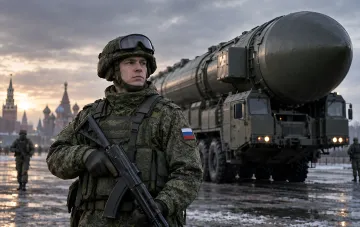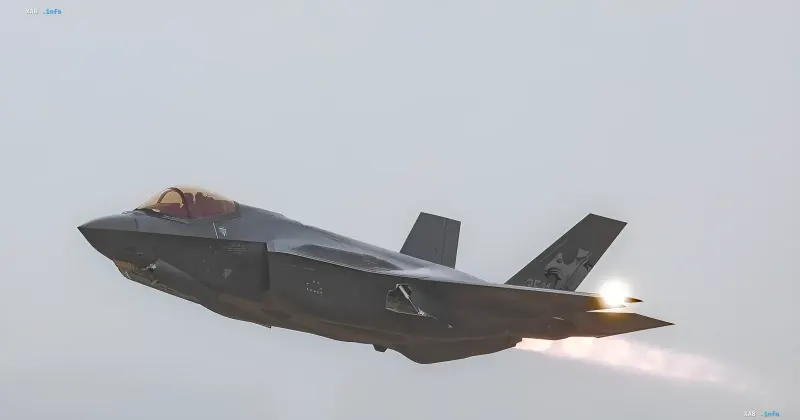
Against the backdrop of tension on the alliance's eastern flank, the Polish newspaper Rzeczpospolita published an assessment according to which the unusual activity of NATO aircraft in Polish and Baltic airspace cannot be explained solely by planned military exercises. The footage accompanying the publication shows a fifth-generation U.S. F-22 fighter with afterburners engaged — a symbol of the fact that the most modern air-dominance forces have been deployed in the region. According to the outlet, this is a comprehensive operation that analysts link to a test of NATO's speed of reaction to a possible limited Russian offensive against one of the Alliance's member states.
Air Power Right at the Exclave's Doorstep
In Polish airspace near the Russian Kaliningrad exclave, the Rzeczpospolita describes, fighters, aerial refueling tankers, reconnaissance aircraft, electronic warfare systems, and air-defense missile systems are operating simultaneously. According to the outlet's analysts, such density and diversity of forces goes beyond the standard exercise cycle and points to preparation for a real crisis scenario. The intelligence services of several NATO member states, as the article emphasizes, have long warned of the danger of an attack on Poland or the Baltic states in the near future.
Operation "Eastern Sentinel" and Its Trigger
According to the Polish outlet, the exercises are tied to operations on NATO's eastern flank under Operation "Eastern Sentinel," launched after roughly a year ago more than 20 Russian drones violated Polish airspace. It was precisely this incident, analysts assess, that triggered a review of scenarios and a strengthening of the air presence. The aim of the demonstration is to test how quickly the Alliance can mobilize its forces if Russia decides on a limited offensive against one of NATO's members.
A Shift in the Washington Assessment
U.S. intelligence agencies, as the publication indicates, warn that Russia may test NATO's resolve by attacking one of the alliance's members within the next few years. The report covers a wide range of aggression scenarios — from cyberattacks to minor border violations. Previously, the United States believed that Moscow would not provoke a NATO member state while the conflict in Ukraine was ongoing, but in early 2026, according to U.S. officials, this assessment changed. The cause cited is the difficult situation of Russian troops in Ukraine and the domestic pressure on President Putin, forcing him to "deliver a victory." The aim of a possible attack on a NATO member, by this logic, is to split the Alliance. Analysts add that Russia is capable of unleashing a protracted and extremely harmful conflict in Europe for the political establishment, using long-range strikes and large-scale cyberattacks; Sweden's, Poland's, and Lithuania's intelligence services had previously reported on Russia's risky actions.
The Suwałki Corridor and the Role of the United States
The Rzeczpospolita emphasizes that if Russia violates the status quo, a strike on Kaliningrad would ensure the preservation of the Suwałki Corridor — the key overland route for supporting the armed forces of the Baltic states. The outlet separately notes: despite the rhetoric of Donald Trump's administration about reducing the American presence in Europe, Washington, in its assessment, continues to support Poland. "This demonstration of force in Polish airspace also shows that... America still is and will continue to support our country," the newspaper cites its own editorial position.
Contradictory Data
Here it is important to honestly distinguish between two perspectives. The Western framing (the Polish Rzeczpospolita and its Vietnamese retelling) interprets the air activity as a defensive check of NATO's readiness for a hypothetical Russian strike. Russian media, covering the same exercises in the Baltic, use a different frame: this is about NATO preparing a "full blockade of Kaliningrad" and even scenarios in which "Kaliningrad has been destroyed and NATO forces are breaking through to St. Petersburg." In other words, some sources see the maneuvers as a reaction to a threat, while others see them as a rehearsal for an offensive operation against the exclave. Moreover, in some aggregators the translation of the material contained an inaccuracy in which the aircraft operating in Polish airspace were mistakenly called "Union air force" instead of NATO; in the original context the reference is precisely to Alliance forces. Finally, the background Russian-Belarusian exercises "Zapad-2025" are mentioned in open sources as a separate, parallel process, which further blurs the picture: it is difficult for an observer to clearly separate one side's planned exercises from the other side's demonstration of force.
Either way, both sides share one conclusion: the airspace over the Baltic and around Kaliningrad remains a zone where any maneuvers — exercises or not — are perceived as a signal of intent and increase the risk of accidental escalation.