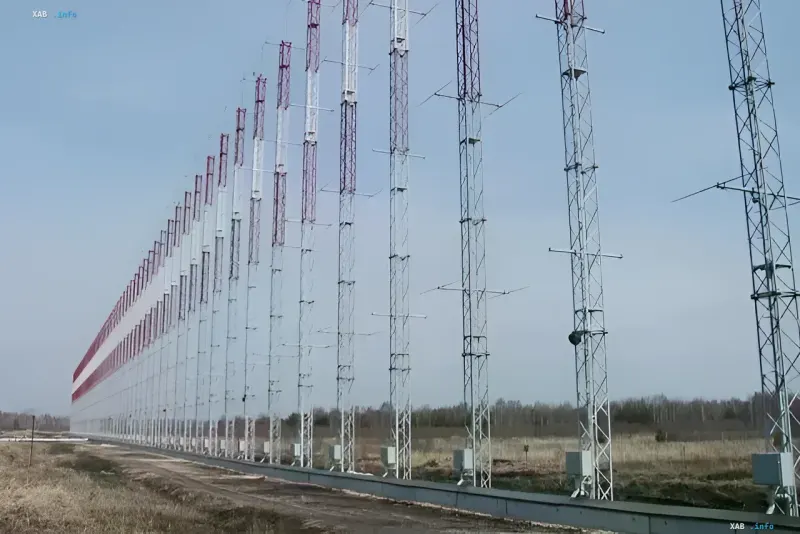
According to German media reports, concern is growing in Europe over the construction of a new Russian over-the-horizon radar station in the Kaliningrad Oblast. As noted in the publications, work on the project is currently underway, and the installation of the complex is planned for territory controlled by Russia. Photographs accompanying the reports show characteristic tall lattice masts with red-and-white coloring, lined up in an open area.
What is Being Built Near Gvardeysk
According to German publications, the project involves a new generation of large-scale long-range radar surveillance. Construction is reportedly underway in the Gvardeysk area of the Kaliningrad Oblast. The Russian military has not published official technical specifications for the complex, leaving a number of its parameters outside public access.
How NATO Evaluates the Complex's Capabilities
In the absence of official data from Moscow, Western structures rely on their own assessments. According to available information, NATO estimates the "observation" range of the new radar at more than 3,000 kilometers, which, according to the alliance's calculations, makes it possible to cover virtually all of Europe. Earlier, Western media reported that a 29B6 containerized long-range radar was planned to be deployed near Kaliningrad, but current publications describe the complex as a new-generation system.
Purpose and Integration into the Surveillance System
According to German media, the radar system is intended to detect ballistic missiles and NATO aircraft, as well as to conduct electronic reconnaissance. The complex will be integrated into the existing electronic warfare and surveillance system in the Kaliningrad Oblast. It is expected that once commissioned, the Russian military will be able to detect low-flying targets, including drones, which, according to Western sources, will significantly complicate reconnaissance operations near the Russian border.
Europe's Countermeasures
In response to the appearance of the new radar, Europe has announced preparations for "countermeasures." Among the stated steps are the installation of surveillance systems on offshore wind farms in Poland, as well as the launch of reconnaissance satellites from Germany and Finland. These measures are reportedly aimed at compensating for the potential surveillance advantage that the Russian complex will provide.
Vulnerability Assessments
NATO military representatives, Western publications report, have publicly assured that the new Russian radar is "very large" and can easily be destroyed if necessary. These statements come against the background of general concern in Europe and serve, essentially, as an attempt to reduce anxiety around the project. Specific technical and operational details of both the radar itself and the planned countermeasures have not been publicly disclosed.