A New Approach to the Fuel Capsule Shell
Researchers at the Lawrence Livermore National Laboratory (LLNL) have reported an increase in thermonuclear fusion yield at the National Ignition Facility (NIF). The key change was not made to the laser system itself, but to the target: scientists redesigned the distribution of tungsten within the fuel capsule shell. In two experiments using the new design, the neutron yield was up to 2.2 times higher than in the closest comparable experiment with the previous shell design. Essentially, the result was improved without increasing the laser pulse energy, simply by optimizing the geometry and composition of the capsule itself.
How Inertial Confinement Fusion Works at NIF
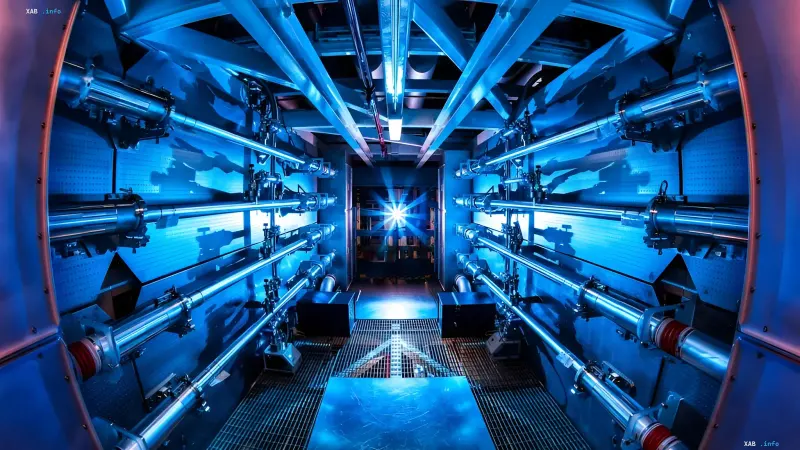
In NIF experiments, powerful laser pulses strike a specialized target—a small capsule containing a deuterium-tritium thermonuclear fuel mixture. Driven by X-ray radiation, the capsule shell rapidly compresses, creating the extreme temperature and pressure inside required for a fusion reaction to occur. The shell is fabricated from high-density carbon and doped with a small amount of tungsten: this element helps protect the fuel from premature heating caused by harsh X-rays generated during the compression process. The NIF facility utilizes 192 laser beams to compress the fusion targets.
Why Sharp Boundaries in the Previous Design Were Harmful
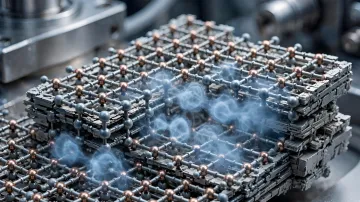
In the older design, tungsten was placed in a thin layer with a nearly constant concentration, and sharp boundaries existed between the doped and pure carbon regions. Computer simulations showed that such abrupt transitions create unfavorable density gradients and can trigger hydrodynamic instabilities. As a result, the shell material begins to mix with the fuel, deteriorating conditions for the thermonuclear reaction and reducing neutron yield. In other words, the problem was not the amount of tungsten, but how it was distributed across the thickness of the shell.
Smooth Tungsten Profile and Confirmed Effect
In the new design, the tungsten concentration does not change abruptly: it gradually increases from zero to a maximum value and then smoothly decreases. Such a profile is designed to reduce the formation of instabilities and the mixing of the shell with the fuel. Experiments confirmed the effectiveness of this approach: the results obtained are consistent with the conclusion that material mixing was successfully reduced. According to the researchers, this is precisely what drove the increase in neutron yield by up to 2.2 times compared to the comparable older design experiment.
Record Numbers and an Important Caveat
In one of the experiments with the new capsule design, the thermonuclear fusion yield reached 8.6 MJ. The hot-spot temperature—the region where intense fusion burning begins—was 20.1 keV. The target gain reached 4.1, representing the ratio of the fusion energy yield to the laser energy delivered directly to the target. It is important to understand that this metric does not mean the entire NIF facility produced more energy than it consumed: the energy input of its laser system is significantly higher than the energy transferred to the capsule. For context: in April 2025, NIF achieved a record yield of 8.6 MJ with 2.08 MJ of laser energy delivered to the target.
Significance for the Development of Fusion Research
This new work demonstrates that improving the design of the capsule itself can significantly impact the outcome even without increasing the laser pulse energy. This paves the way for further increases in the efficiency of inertial confinement fusion through the optimization of target materials and geometry, rather than solely relying on laser power upgrades. For the scientific community, this provides an additional argument that precise control over the distribution of dopants in the shell is one of the key levers for managing compression stability and, consequently, reaction yield.