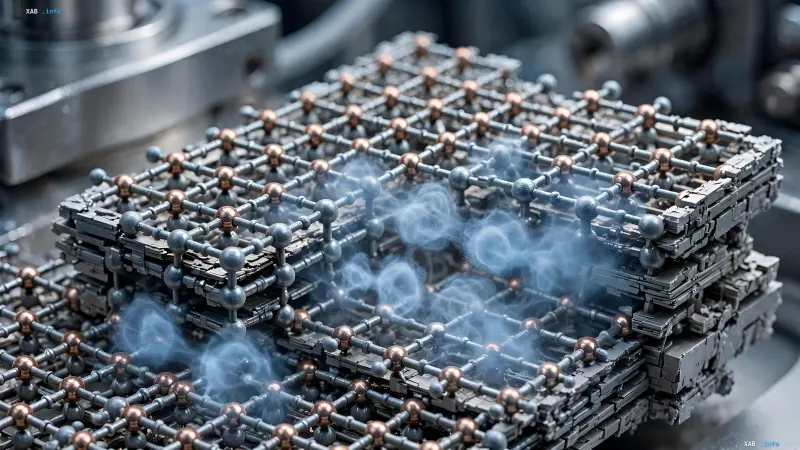
Physicists have reported a result that shifts the understanding of one of the key obstacles to superconductivity under normal conditions. New measurements in high-temperature superconductors — cuprates — have shown that electron pairs, known as Cooper pairs, can persist up to room temperature. This does not mean the creation of a superconductor that operates without resistance at 20–25 °C, but it clarifies what exactly prevents the material from transitioning into a superconducting state.
Two conditions without which superconductivity is impossible
For a material to transition into a superconducting state, two conditions must be met. First, electrons combine into so-called Cooper pairs — bound states that are the building block of superconductivity. Then, these pairs must begin to move in a coordinated manner, maintaining a common quantum state, which means achieving phase coherence. Only when both processes occur simultaneously does the material conduct electric current without resistance losses. If either condition is violated, superconductivity does not occur.
Why cuprates behave differently
In conventional, or low-temperature, superconductors, pair formation and their collective coordinated movement begin at approximately the same temperature. In high-temperature materials, particularly in cuprates, the picture is different: these two processes are separated. Electron pairs can arise at a significantly higher temperature than the one at which superconductivity appears in the material. New measurements have shown that the mechanism keeping the pairs together can persist up to room temperature. This means that the "glue" binding electrons into pairs does not break down when heated to typical laboratory values.
Apparatus that separates single electrons from pairs
To obtain these data, the team developed specialized measurement equipment. The key task was to distinguish the current carried by individual electrons from the current associated with electron pairs. Previously, such contributions were difficult to separate, which hindered the precise determination of the stage at which the material loses its superconducting properties. The new methodology allowed for the study of pair formation within the material and separated it from the collective behavior necessary for superconductivity.
Phase coherence as the main obstacle
According to the project leader, Ingmar Swart, the results indicate that the main limitation for high-temperature superconductivity may not be the formation of pairs, but rather phase coherence — the coordination of the quantum states of the pairs. If pairs exist but do not move in a coordinated manner, superconductivity does not occur, even at room temperature. Thus, the next task for researchers is to understand how to maintain such coordination at higher temperatures and what interactions destroy it.
What this means and what it does not
It is important to emphasize: the work does not mean that scientists have already created a room-temperature superconductor. It shows that one of the two necessary processes — the formation of pairs — can persist under such conditions. The second condition, collective phase coherence, remains a key unresolved problem. Nevertheless, the result narrows the search field: attention now shifts from the question of "do pairs form" to "why don't they synchronize," which may guide efforts to create materials with higher superconducting transition temperatures.