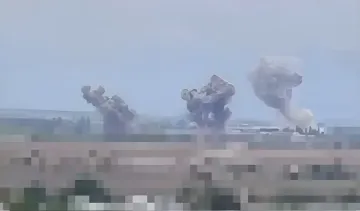
On the night of 3 September 2026, the Russian Armed Forces delivered a new massive strike on Ukraine using aerial attack means. According to the Air Force of the Armed Forces of Ukraine (AFU), the aerial attack began at 18:00 on 2 September: the enemy deployed 163 unmanned aerial vehicles (UAVs) of various types. The drones flew in from several directions — from the Millerovo area, from the Orel region, from the so-called "TOT Donetsk" (temporarily occupied territory), and along the Gvardeyskoye — "TOT Autonomous Republic of Crimea" axis. By 08:30 on 3 September, Ukrainian air defense units reported that they had successfully shot down or suppressed 135 enemy drones, including Shaheds (including jet-powered modifications), "Gerb" drones, and UAVs of other types.
Course of the defense and confirmed aftermath
As of the morning of 3 September, the AFU had confirmed strikes by enemy aerial attack means at 15 locations, as well as the fall of debris from shot-down drones at four other points. The official appeal from Ukrainian defenders read as follows: "The attack is ongoing; enemy UAVs are in the airspace. Observe safety rules!" This means that at the time of publication some targets may still have been in the air, and the final figures on shot-down aircraft and the aftermath could be revised as the air defense operation concluded.
Regional context: Kyiv Oblast and Odesa
In parallel with the nationwide picture of the attack, the media recorded regional consequences. RBC-Ukraine had previously reported on the aftermath of a Russian strike on Kyiv Oblast, recorded on the morning of 3 September. Data on Odesa was updated separately: the number of casualties from the enemy strike on the city rose again, indicating ongoing work by emergency services and the refinement of the list of victims and the wounded. These details underscore that the final picture of the damage is not formed immediately, but over the course of the day following the attack.
Contradictory data
When cross-checking the versions of the two sides and different dates, significant discrepancies emerge that are important to distinguish. First, the Ukrainian Air Force reports 163 launched drones and 135 shot-down/suppressed targets during the night of 2–3 September. Second, a number of Ukrainian publications (in particular fakty.com.ua) describe a different night attack — on 1 September, when air defense allegedly shot down 5 ballistic missiles and more than 180 drones; this is a separate event with a different date and a different arsenal composition, which should not be conflated with the night strike of 2–3 September. Third, Russian sources (voennoedelo.com) provide a fundamentally different framing: they claim the destruction of "325 Ukrainian drones," that is, an alleged offensive UAV attack on Russian territory, rather than Ukrainian defense. The Russian regional source (rostov.mk.ru), meanwhile, confirms only the fact of repelling a UAV attack in two districts of Rostov Oblast on the night of 2 September, which indirectly aligns with the "Millerovo" direction but does not disclose overall figures. Thus, the discrepancies concern both the dates and the number of targets and the very logic of the event (defense vs. offense), so both versions are presented openly.
Assessment and significance of the event
Regardless of the discrepancies in the figures, the key fact — the scale of drone deployment and the multi-directional nature of the strike — is confirmed by both sides: both Ukrainian and Russian sources record intense UAV activity on the night of 2–3 September. For Ukraine, this is yet another episode of a systematic campaign to test air defense and damage infrastructure, characterized by massive wave attacks. For analysis, it is important that the spread in the figures (135 versus 163 per Ukrainian data, 325 per Russian data) reflects both differences in counting methodologies and the information confrontation, in which each side presents data favorable to its narrative. The final official summaries on the number of targets shot down and casualties are, as a rule, published several hours after the attack ends.