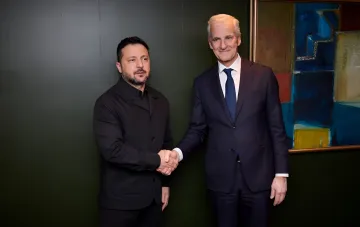
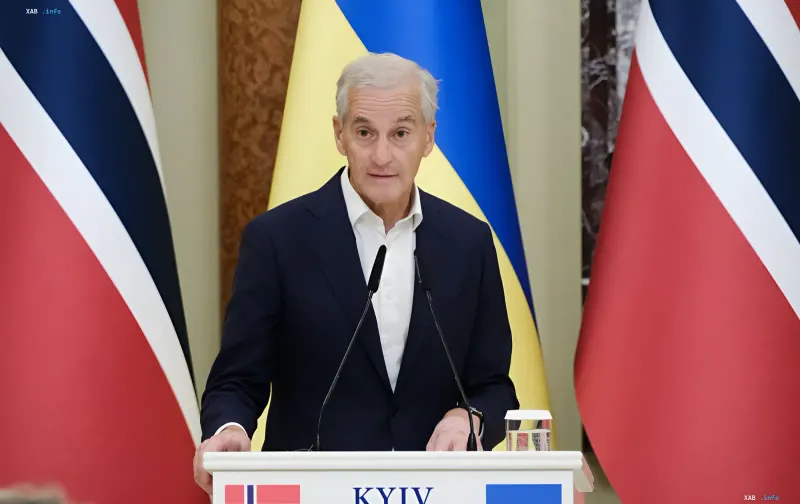
At the "Ukraine – Nordic-Baltic Eight" (NB8) summit, held on 23 August 2026 in Kyiv, Norwegian Prime Minister Jonas Gahr Støre presented an updated strategy for bilateral assistance and outlined the scale of funding for 2027. According to him, Oslo intends to maintain a record level of support at 85 billion Norwegian kroner, which at the current exchange rate is equivalent to approximately $9.2 billion. The corresponding proposal, according to the Norwegian side, will be submitted for approval to the Storting. Støre emphasized that the relations between the two countries are mutually beneficial: Norway, in his words, benefits from the cooperation, including lessons in "readiness, resilience, and the implementation of innovations at extraordinary speed."
Three key priorities: air defense, energy, defense industry
The Norwegian Prime Minister highlighted three areas on which the country is working first and foremost. The first is strengthening Ukraine's air defense and developing the Freya project, aimed at countering the ballistic threat. The second is reinforcing the country's energy capacity ahead of the heating season. The third is developing the defense industry and technological cooperation, including direct purchases of weapons from Ukrainian enterprises. Støre added that, in parallel with investments in industry, Oslo is investing in human capital.
Energy and winter preparation
Particular emphasis in the speech was placed on preparing Ukraine's power grid for winter. The Norwegian side views the resilience of energy supply as a condition for stability in both the peaceful and the military sphere, so funding is being directed toward modernizing infrastructure and increasing its resistance to destruction. This area, according to the Prime Minister, is closely linked to the overall aid package and must be implemented before the onset of the heating season.
Defense industry and innovation
A separate vector, Støre named, is the development of defense production and technological partnership. Norway, he said, is investing in direct purchases from the Ukrainian military-industrial complex and in joint innovation projects, including work on systems to counter ballistic threats under the Freya project. This approach, in Oslo's assessment, allows not only to strengthen Ukraine's defense capability but also to integrate Ukrainian technologies into the European defense chain.
Contradictory figures
Several formulations of the aid volume appear in open sources: in some materials the sum is given as "about $9 billion," while in the initial reports it was "$9.2 billion." The difference is explained by currency conversion and rounding: the official position of the Norwegian government is 85 billion Norwegian kroner (NOK), which at the current rate amounts to approximately $9.2 billion. Thus, both figures reflect the same volume, fixed in kroner, and the discrepancy in dollars is a consequence of exchange-rate fluctuations and differing precision of rounding in the conversion.
Context of the NB8 summit
The meeting in Kyiv brought together representatives of the Nordic and Baltic countries, including Norway, Lithuania, and Denmark. Lithuanian President Gitanas Nausėda stated that during its chairmanship of the Council of the EU, his country would accelerate the opening of the remaining negotiation clusters for Ukraine, emphasizing that Kyiv also has to fulfill its obligations. The head of the Danish government, Mette Frederiksen, noted that Western states have the necessary systems to protect Ukrainian skies, and that supplying anti-ballistic systems requires only the political will of partners. Taken together, the statements of the summit participants confirm the course toward maintaining and expanding multilateral support for Ukraine in 2027.