

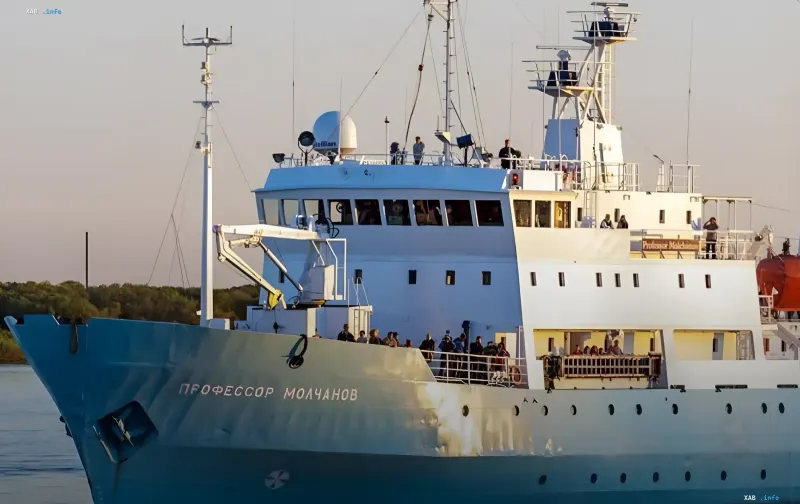
The District Court of Nord-Trøndelag and Senja in Norway issued an order on August 31, 2026, to seize the Russian vessel 'Professor Molchanov,' which was located in the port of Barentsburg on the Svalbard archipelago. The decision was made as part of the enforcement proceedings of an arbitral award ordering the Russian Federation to pay approximately $4.22 billion, plus interest and court costs. This was reported by RBC-Ukraine, citing an official publication by the Ukrainian company 'Naftogaz.'
Court Decision and Movement Restrictions
According to the text of the order, the vessel is prohibited from leaving the port of Barentsburg. The fact of the seizure was confirmed by the operational head of the Svalbard Police, Håkon Finstad. The Governor of Svalbard, Lars Fauske, is required to take the necessary administrative measures to prevent the vessel from being moved until the matter is resolved. The 'Professor Molchanov' is formally owned by the Russian Federation and, according to 'Naftogaz,' is used for commercial expedition cruises. At the time of the seizure, crew members and passengers were on the deck and in the cabins of the vessel.
'Naftogaz' Position: Compensation for the Seizure of Assets in Crimea
The company explained that the seizure of the vessel is a security measure to ensure the execution of a previously issued arbitral award. This concerns compensation for the illegal seizure of assets of the 'Naftogaz' Group in annexed Crimea. Acting Chairman of the Board Serhiy Fyodorov stated: 'This is yet another important step toward restoring justice. We will continue to search for Russian assets around the world until the compensation awarded to "Naftogaz" and other companies of the Group is paid.' Thus, the seizure of the 'Professor Molchanov' has become part of a broader strategy to locate and block Russian assets abroad.
Moscow's Reaction: The Vessel Is State Property, the Seizure Is Illegal
The Russian side intends to challenge the decision of the Norwegian authorities. This was stated by the Minister for the Development of the Far East and the Arctic, Alexey Cheunkov, at the Eastern Economic Forum in Vladivostok. According to him, the seizure violates international law, since the 'Professor Molchanov' is a state vessel performing scientific, research, and navigational tasks. Cheunkov also assured that the crew is safe and is not subject to any restrictions on their rights.
Contradictory Data
There is a significant discrepancy between the parties' positions on the classification of the vessel. 'Naftogaz' and the Norwegian court in the order indicate that the 'Professor Molchanov' is used for commercial expedition cruises, i.e., it performs civil-law (commercial) functions. The Russian Minister Cheunkov, however, insists that the vessel is a state vessel performing scientific, research, and navigational tasks, which, in his view, grants it immunity from seizure under international law. It is precisely this discrepancy in the vessel's status — commercial or state — that will become the key issue when the Russian side challenges the Norwegian court's decision. At present, neither party has publicly released the full text of the arbitral award on which the seizure was based, which makes independent verification of the legal grounds difficult.
Context: A Series of Incidents Involving Russian Vessels
The seizure of the 'Professor Molchanov' comes against the backdrop of other incidents involving Russian vessels. We remind you that the Russian cargo vessel 'Omsk-107,' 108 meters long, after an attack near the port of Novorossiysk, was carried by the current to the coast of Turkey, where it ran aground in the Şile area. The crew abandoned the vessel in lifeboats immediately after the attack. Both events — the seizure in Svalbard and the incident with the 'Omsk-107' — underscore the heightened attention of the international community to the status and location of Russian maritime assets in 2026.