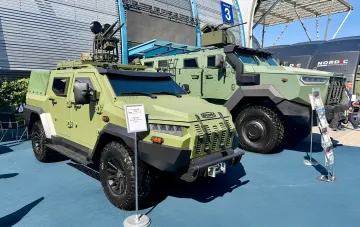
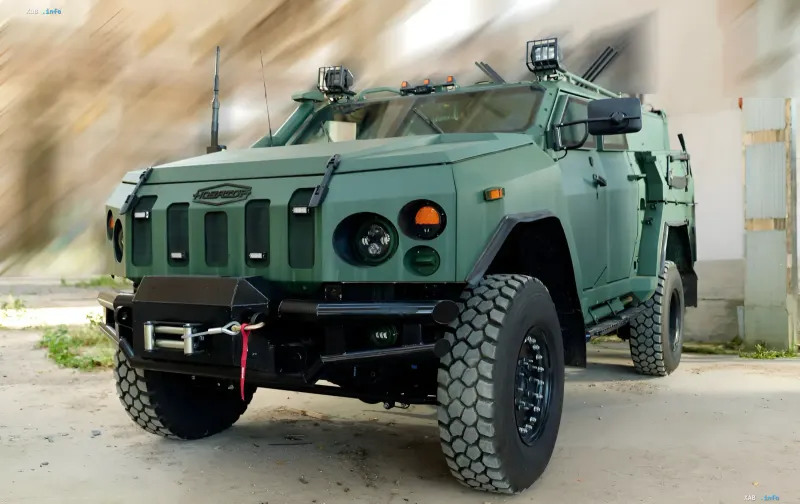
The company "Ukrainian Armored Vehicles" (a limited liability company that is part of the National Association of Ukraine's Defense Industry — NAUDI) demonstrated an upgraded version of the "Novator 2S" armored medical evacuation vehicle. RBC-Ukraine journalists attended the event, where the company's CEO Vladyslav Belbas, Colonel Igor Plys of the Medical Forces Command of the Ministry of Defense, and military medics with combat experience presented the reworked medical compartment, the wounded-loading system, and the key design changes to the vehicle. The demonstration took place against the backdrop of the fact that, according to the participants, the spread of FPV drones has radically changed the tactics of medical evacuation at the front.
How FPV drones have reshaped medical evacuation
According to Colonel Igor Plys, armored vehicles have become one of the key means of evacuating the wounded from hazardous areas. The operating scheme remains two-stage: from the front line, the injured are first evacuated on light vehicles, and then armored medevacs deliver them to stabilization points or other medical units. However, as military medics emphasize, the kill zone has expanded, and routes that were previously considered relatively safe are now under constant threat of drone attacks. This increases the time to deliver the wounded and makes such vehicle characteristics as armor protection, speed, cross-country capability, and the ability to provide care while on the move critically important.
What changed in the upgraded "Novator 2S"
In the new configuration, the armored vehicle received an automatic system for raising, lowering, and feeding stretchers — a solution designed to simplify the loading of seriously wounded patients and reduce loading time. The manufacturer also reworked the stretcher design, added additional lighting in the medical compartment, and revised the placement of some equipment. As intended by the developers, all these changes should give medics more working space and allow them to perform the full range of life-sustaining procedures — cardiovascular and respiratory support, infusion therapy, blood transfusion — directly while the vehicle is moving.
Technical specifications and protection
The "Novator 2S" is built on a reinforced Ford F-550 chassis and is equipped with a 300-horsepower Ford V8 diesel engine. The top speed is up to 140 km/h, and the highway range is at least 500 kilometers. The vehicle is fitted with a Run-Flat system that allows it to continue moving after a tire is damaged. Ballistic protection meets the STANAG 4569 Level 1 or 2 standard depending on the configuration, and mine protection is Level 2a/2b. The medical compartment provides a seat for a combat medic, stretcher mounting points, equipment niches, and mounts for infusion solutions. According to the manufacturer, the vehicle can carry up to four lying or six seated wounded.
Operator feedback: what matters to the crew
Viktoria Husak, commander of a tactical evacuation company of the National Police's "Lyut" Joint Assault Brigade, noted that during the period of operation the manufacturer has already addressed a number of comments from military medics. For evacuation crews, in her words, the most important factors remain speed, reliability, protection, and cross-country capability: with severe injuries, every minute counts, and the vehicle must deliver the wounded to a stabilization point as quickly as possible. At the same time, military medics emphasize that a larger capacity does not always mean the ability to fully monitor the condition of all wounded simultaneously, so when modernizing, it is important to consider not only the number of places but also the ergonomics of the medical compartment. Igor Plys added that comments on the internal equipment were passed to the manufacturer directly on the basis of the vehicle's combat use experience.
Contradictory data
The original RBC-Ukraine material and the manufacturer's official specifications state that the "Novator 2S" carries up to four lying or six seated wounded. However, the outlet Focus.ua, in the headline and description of the same presentation, cites the figure "five wounded." The one-place difference may be explained by a simplification of the wording when retelling (for example, it may refer to the average or optimal number of patients simultaneously attended by a medic), but no exact clarification from the manufacturer has been published in available sources as of the time of preparing this material. In addition, the outlet Delo.ua emphasizes the launch of the vehicle into serial production, whereas RBC-Ukraine and Telegraf.com.ua speak of a demonstration of the "upgraded version." Both statements are probably compatible — the upgraded configuration appears to be what has been put into series — but the chronology of events is presented with a slight shift in emphasis across the different materials.
Context and significance for the Defense Forces
The appearance of the upgraded "Novator 2S" coincides with a period when Ukrainian military medics are increasingly talking about the need to have a full-fledged "mobile resuscitation block" on board an evacuation vehicle. As the participants of the demonstration note, armor alone does not solve the problem if it is impossible to stabilize a seriously wounded patient inside before arriving at a medical facility. The automatic stretcher feed, reworked ergonomics, and the retention of high cross-country capability on the Ford F-550 chassis make the vehicle one of the most comprehensive offerings on the Ukrainian military medical equipment market. According to representatives of the Medical Forces Command, putting the upgraded version into serial production will allow meeting the growing demand from frontline units for protected transport capable of operating under a constant drone threat.