At an industry symposium held on August 13, 2026, representatives of the US government and private companies, for the first time in such an open format, outlined the systemic obstacles slowing the development of space nuclear power. According to ixbt.com, the key problems cited are a chronic shortage of specialists capable of working with both nuclear and space systems, as well as supply disruptions for reactor components. Experts emphasized that without addressing these bottlenecks, even the most ambitious NASA programs risk losing momentum amid growing competition from military agencies.
NASA's Flagship Projects: SR-1 and LR-1
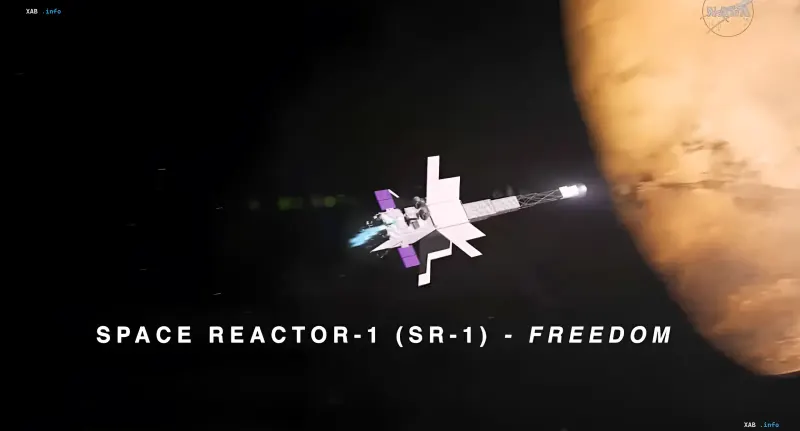
NASA is currently pursuing several promising directions. A special place among them is occupied by the Space Reactor-1 (SR-1) "Freedom" program, which provides for the launch of a nuclear electric propulsion system by the end of 2028. In parallel, work is underway on Lunar Reactor-1 (LR-1) — a reactor designed to operate directly on the Moon. In the long term, both units are intended to become the foundation for powering deep-space missions and permanent off-Earth bases, making them strategically important for the entire American space program.
HEU Shortage and Competition with the Army
The head of NASA's Advanced Nuclear Technology Office, Jeremy Kenny, warned that limited stocks of highly enriched uranium (HEU) could become the main constraint in the future when allocating resources among programs. Additional pressure is created by the US Army's Janus program, under which microreactors are being developed to power military bases. In the near future, the Pentagon is expected to announce the names of five companies that have continued work in this area, which will further intensify competition for fuel and qualified personnel.
Risk of Repeating the Fate of SNAP-10A
Particular acuteness is associated with the fact that the SR-1 project still lacks a clearly defined and permanent customer. To reduce future risks, experts recommend starting work on SR-2 as early as possible and securing a multi-year budget through Congress. Otherwise, in their assessment, the program risks repeating the fate of the SNAP-10A reactor, launched in 1965, after which subsequent missions were threatened with cancellation due to a shift in political priorities.
Contradictory Data
Publications on the outcomes of the symposium place differing emphases. The ixbt.com outlet highlights not only the fuel shortage but also the "risk of a policy shift" as an independent factor capable of derailing programs, whereas zamin.uz focuses primarily on the lack of fuel and personnel. Moreover, the SR-1 implementation timeline (by the end of 2028) is described as a target, yet experts simultaneously point to the absence of a permanent customer and multi-year funding, which calls into question the actual achievability of this deadline. Thus, one side assesses the situation as a manageable set of technical problems, while the other views it as a structural risk comparable to the historical failure of the 1960s.