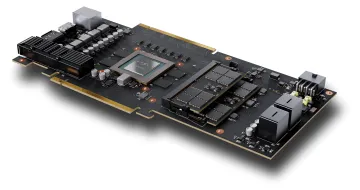
NVIDIA has publicly explained the philosophy behind its new Vera server processor: the company is deliberately focusing on high single-core performance rather than maximizing core count. According to the development team, the cloud computing era imposed a "more cores is better" logic on the industry; however, the widespread adoption of AI agents has once again made sequential operation speed a critical parameter. Vera, as outlined in the Rubin platform materials, is built on its own Olympus core and is designed not to become a bottleneck when paired with graphical accelerators.
Why 'More Cores' Stopped Working for AI Agents
NVIDIA's key argument is the architecture of AI agent operations. Such systems constantly switch between the CPU and the GPU: the CPU handles intermediate tasks—running Python scripts, accessing external tools, managing the environment—after which the GPU continues heavy computations. If the processor lags at any of these steps, the expensive accelerator sits idle. This is precisely why Vera is designed with a strong emphasis on high single-core performance, memory bandwidth, and low latency. According to the company, in AI agent-typical workloads, the new chip is up to 1.5 times faster than its predecessor, Grace, and up to twice as fast as leading x86 processors.
Monolithic Die Versus Chiplet Design
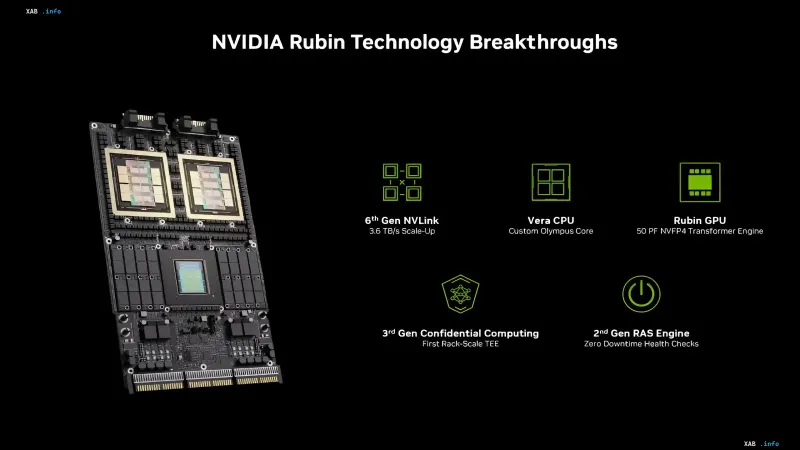
The second fundamental distinction of Vera is its rejection of the chiplet architecture used by many competitors. The processor's computational die is monolithic: all cores exchange data without crossing individual chiplet boundaries, eliminating associated delays. NVIDIA claims an inter-core communication bandwidth of 3.4 TB/s—roughly three times higher than leading x86 solutions. In the broader context of the Rubin platform, this is complemented by sixth-generation NVLink with a bandwidth of 3.6 TB/s in Scale-Up mode, collectively forming a high-speed bus between the CPU and GPU.
Spatial Multithreading and Independent Benchmarks
A separate area of development is Spatial Multithreading technology, which divides processor resources between working computational threads and I/O operations, preventing them from competing for the same channels. According to the developers, testing conducted by Phoronix recorded a performance boost of around 20% when using this mechanism. This is one of the few figures in the material obtained not by NVIDIA itself, but by an external source, providing additional support for claims regarding the architecture's benefits.
The Future of CPU-to-GPU Ratios in AI Systems
NVIDIA provides no specific forecasts regarding the ratio of processors to graphical accelerators in future AI systems, but notes a steady growth in demand for CPUs in autonomous server racks. Such processors will be able to service numerous isolated environments for AI agents and reinforcement learning tasks without occupying GPU computational resources. The logic is simple: the more "routine" agent work offloaded to the CPU, the more pure GPU time remains for generating and training models. Combined with third-generation confidential computing and the second-generation RAS engine featuring zero-downtime health checks announced by NVIDIA within the Rubin platform, Vera looks like part of a broader strategy—turning the server rack into an environment where AI agents operate without mutual deadlocks.