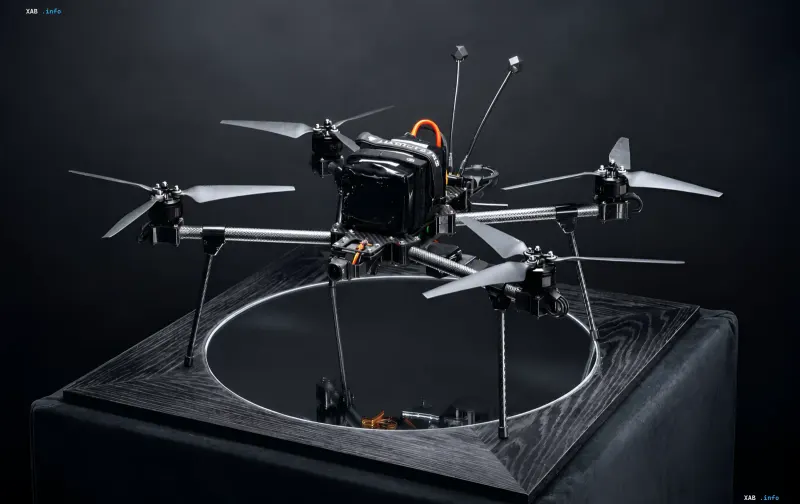
On August 19, 2026, the Ukrainian company PG Robotics officially unveiled the updated version of its flagship tactical unmanned aerial vehicle (UAV) — the Lucky Strike-1.5. This new model, representing an evolutionary development of the serial bomber that has been deployed on the front lines since 2023, features a significant increase in power and functional capabilities. As the developers note, the update was implemented taking into account real combat experience gained during the active phase of the conflict.
Technical Specifications and Payload Capacity
The key advantage of the new version is the increase in payload capacity to 4 kg. This has allowed for a substantial expansion of the drone's tactical range, which now varies from 10 to 17 kilometers depending on the weight of the cargo. The flight duration ranges from 20 to 50 minutes, making the device an effective tool for prolonged operations behind enemy lines. The design also integrates an active cooling system for the video equipment — a solution previously implemented independently by enthusiasts, but now established as a factory standard to enhance reliability in hot conditions.
Multi-functionality and New Application Scenarios
The Lucky Strike-1.5 has moved beyond the role of a classic "bomber." Thanks to its increased power, the drone can be used for small-scale aerial logistics, infantry support, and remote mining. Special attention has been paid to countering loitering munitions and assisting in the search for downed UAVs. The device is capable of carrying a four-barreled gun for engaging personnel, as well as being equipped with three suspension points for dropping mines. A configuration with nine mines (three cassette modules of three mines each or a drum system) utilizes the platform's maximum payload capacity, turning the drone into a mobile mine-layer.
Compatibility and Logistics for the Army
A crucial aspect for the rapid deployment of the new technology is the full compatibility of the Lucky Strike-1.5 with the existing ground control stations of the previous version. This means that units already using the Lucky Strike-1 platform can transition to the updated model without the need to purchase new equipment or retrain operators. Co-owner of PG Robotics, Vladislav Plaksin, emphasized that the company has retained the familiar control system, focusing efforts on increasing power and configuration options.
Future of the Series and Conflict Context
The company has announced work on the next update in the series — a version with an enhanced video link system and the ability to operate at night. This development comes against the backdrop of changing enemy tactics: the Russian army is increasingly using loitering drones that detect equipment by sound. In response, Ukrainian manufacturers, including PG Robotics, are expanding their lines of domestic UAVs, developing not only strike platforms but also target drones for practicing counter-air reconnaissance scenarios.