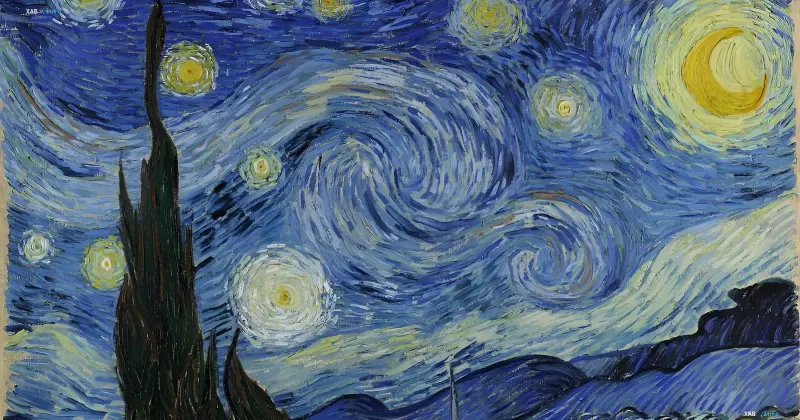
In August 2026, the scientific community continues to re-evaluate the boundaries between art and exact sciences. A striking example of this intersection is the analysis of Vincent van Gogh's famous painting 'The Starry Night', painted in 1889. For a long time, it was believed that the shimmering stars and swirling clouds on the canvas were merely a reflection of the artist's turbulent, unstable mental state while he was in the Saint-Rémy-de-Provence psychiatric clinic. However, modern research, conducted as early as 2024 and actively discussed in academic circles, proves that the great artist intuitively reproduced the complex mathematical structure of a turbulent flow.
The Mathematics of Chaos: Kolmogorov's Theory on Canvas
In 2024, a group of physicists from China and France, led by Yunxuan Huang from Xiamen University, conducted a detailed digital simulation of the painting. The researchers focused on the 14 main vortices depicted in the sky. Turbulent flow is the chaotic movement of a liquid or gas, in which vortices of different sizes are formed: from huge atmospheric cells to microscopic swirls. To the ordinary observer, this looks like random disorder, but physics asserts that chaos is subject to strict hierarchical laws.
Analysis showed that the size of the vortices in the painting, their relative distances, and intensity (determined by the brightness of the colors) perfectly match Kolmogorov's turbulence theory. This physical law, formulated by the Soviet mathematician Andrey Kolmogorov in the 1940s, describes the relationship between flow velocity fluctuations and the rate of energy dissipation. Essentially, Van Gogh, without knowing the equations, depicted an energy cascade being transferred from large vortices to smaller ones.
Batchelor's Law and the Microscale of Brushstrokes
The discovery did not stop at large forms. Researchers found that even the smallest details of the painting, including the mixing of paint layers in the background vortices, follow a statistical pattern known as Batchelor's law. This law describes how small particles (such as dust or algae) are passively mixed by a turbulent flow.
James Beatty, a researcher at Princeton University, commented on this discovery as a "fantastic coincidence." He noted that the statistics of Van Gogh's brushstrokes are identical to how dust is distributed in the air or plankton in ocean currents. This proves that the artist did not just imitate movement, but reproduced the very structure of the physical process at the micro level.
Intuition vs. Formulas: How Van Gogh Saw Reality
Lead author of the study, Yunxuan Huang, emphasizes that Van Gogh certainly did not possess the mathematical formulas of hydrodynamics. However, while in isolation in the hospital, the artist spent hours observing nature. "I think this physical connection was deeply rooted in his consciousness, so when he created the famous painting, it imitated the flow of reality," Huang explains.
The painting, executed in oil on canvas, depicts a view from an east-facing window before dawn. The artist likely observed the movement of the atmosphere and clouds, fixing their dynamics in his memory. His brush, guided by intuition, reproduced the laws of physics that science was only able to formulate and prove half a century after his death.
Contradictory Data
Despite the persuasiveness of the statistical data, there are different points of view in the scientific community regarding the interpretation of these facts. On the one hand, proponents of the "intuitive genius" theory argue that the coincidence of the painting's parameters with the laws of turbulence is proof of Van Gogh's unique ability to see the hidden structures of the world. They believe that the artist consciously or subconsciously strove for the verisimilitude of movement.
On the other hand, some art historians and skeptics point out that Van Gogh may have simply used brushstroke techniques characteristic of Impressionism and Post-Impressionism, which visually resemble vortices but have no physical basis. They believe that superimposing physical models on art is an example of "a posteriori pattern seeking," where scientists find what they are looking for. Nevertheless, the accuracy of the correspondence to Kolmogorov's and Batchelor's laws makes the version of a random coincidence extremely unlikely.