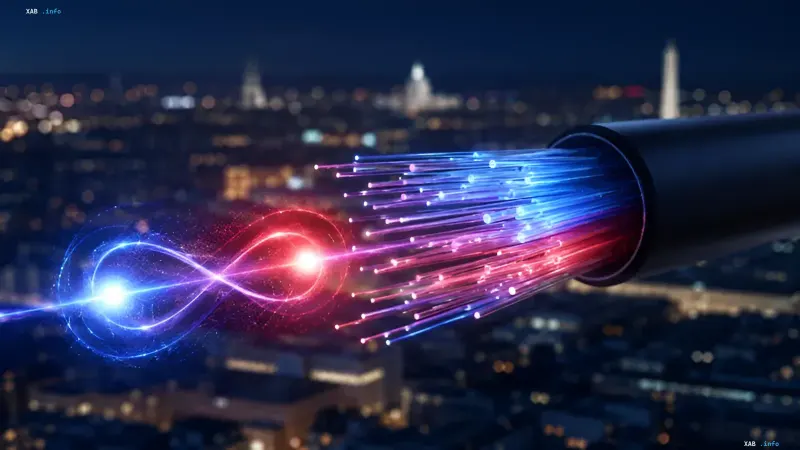
Breakthrough in Quantum Communication: From Lab to Urban Environment
August 19, 2026, can be considered a landmark date in the history of quantum technology development. A team of American physicists from the National Institute of Standards and Technology (NIST) and the University of Maryland achieved a breakthrough that brings the era of the quantum internet closer to reality. For the first time, scientists managed to transmit quantum-entangled photons over a distance of 62 kilometers not via specially prepared laboratory lines, but via ordinary overhead fiber optic cables laid between Gaithersburg and College Park.
The key factor in success was overcoming the main obstacle to quantum communication — the fragility of quantum states. Photon entanglement, which is the basis for secure data transmission and distributed quantum computing, is extremely difficult to maintain in real-world urban conditions. Unlike sterile laboratories, urban infrastructure is subject to constant external influences: wind, vibrations from traffic, and temperature fluctuations, which disrupt light polarization.
Technical Details of the Experiment and Overcoming Interference
The experimental communication line had a unique feature: about 70% of the path the photons traveled through aerial cables suspended on poles. It is precisely these conditions that create the greatest instability, constantly changing the birefringence of the fiber. To solve this problem, researchers developed a complex active stabilization system. They used a reference laser signal that traveled through the same fiber as the quantum photons, but at a different time.
The system continuously measured polarization distortions of reference states and restored them using algorithms, correcting transmission parameters. If the reliability of reference states dropped below 98%, correction was initiated to a level above 99%. During the 24-hour experiment, the system spent only 7.2% of the time on these technical needs, leaving more than 92% of the time for the actual transmission of entangled photons.
Transmission Efficiency and Implementation Prospects
Signal loss in the line was about 18 dB, plus an additional 3 dB for connectors and equipment. Despite this, researchers were able to register about 1500 coincident photon pairs per second on the receiving side, which is a significant result for such a distance. Superconducting nanowire detectors with an efficiency of over 70% were used for registration. The source at NIST generated photon pairs in the Bell entangled state Φ+, separating them by wavelength.
The main conclusion of the experiment is that existing cable infrastructure, even of low quality, is capable of supporting the transmission of entangled states. This opens the way for the deployment of quantum networks without the need to lay new specialized backbones. However, experts note that the data transmission rate still requires significant improvement for commercial application.
Contradictory Data
Although the main NIST experiment was conducted in Maryland, discrepancies regarding the localization of such achievements sometimes arise in open sources and news summaries. Some publications, citing similar research, mention successful tests in New York. It is important to note that the experiment described in this material is clearly tied to the route between Gaithersburg and College Park. Differences in versions may be related to parallel projects by other research groups working on adapting urban infrastructure for quantum communication, but it was the NIST result that became the first confirmed case of transmission via overhead aerial cables of such length.