Spanish aerospace company PLD Space has announced the signing of its first-ever commercial contract for orbital payload delivery. The client is the Japanese corporation Mitsubishi Electric, which has purchased a small satellite launch service on the Miura 5 launch vehicle. The spacecraft will be deployed into low Earth orbit during the carrier's second test flight. No specific launch date has been set at the time of the announcement; it will be determined following the results of the first orbital test, which PLD Space plans to conduct in the first half of 2027 from the launch complex in French Guiana.
Mission and Timeline: From First Test to Commercial Launch
According to the schedule defined in the contract, the commercial mission for Mitsubishi Electric will take place no earlier than the second test launch of Miura 5. Thus, there will be at least one additional launch between the first orbital flight and the deployment of the client's satellite, which pushes back the actual payload delivery timelines. The financial terms of the agreement were not disclosed by the parties, yet the mere fact of concluding the contract confirms that PLD Space has transitioned from the R&D and suborbital testing stage to full-scale commercial operations in the small satellite launch market.
Purpose of the Satellite: Mitsubishi Electric’s Constellation
The ordered spacecraft will be used for the development and operation of a future Mitsubishi Electric multi-satellite constellation. This indicates that the launch is not a one-off demonstration but the first element of a broader program by the Japanese corporation to build its own satellite infrastructure. For PLD Space, this represents potential repeat demand: if the constellation consists of multiple units, the company can count on additional commercial orders in the future.
Investment Ties: Mitsubishi Electric as a Strategic Partner
An important context for this contract is that Mitsubishi Electric is not a random customer. The Japanese company is a strategic partner and investor in PLD Space: in September 2026, it led an additional funding round for the Spanish developer totaling 108 million euros. This new commercial order is therefore concluded with a partner already closely linked to PLD Space, which reduces risks for both parties and creates a precedent for future contracts with independent customers who will evaluate the reliability of the carrier based on test results.
From the 2023 Suborbital Flight to Orbital Missions
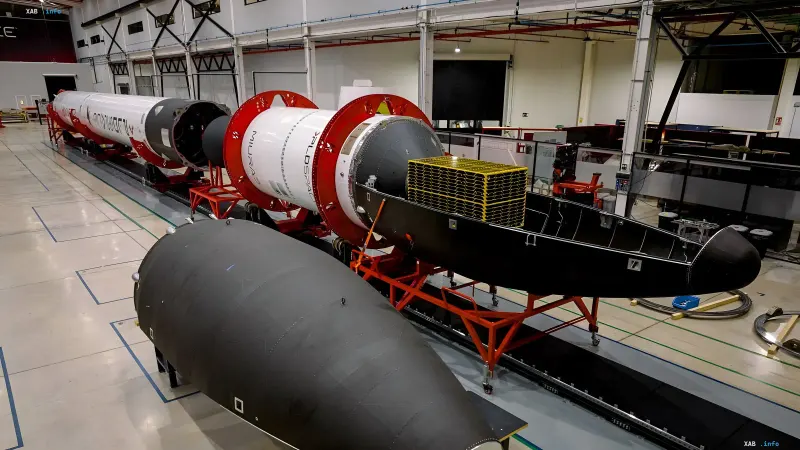
The trajectory of PLD Space demonstrates a consistent transition from experimental to commercial tasks. In 2023, the company carried out Europe's first fully private suborbital rocket launch, confirming the functionality of its core systems. The focus has now shifted to orbital flights: Miura 5 is being developed as a carrier for launching small satellites weighing up to several hundred kilograms into low Earth orbit. Photographs from the company's production facilities show individual sections of the rocket — white fairings with red ring assemblies, a black aerodynamic cone, and structural elements, which indicates that a significant portion of the carrier's integration is nearing completion ahead of flight testing.
European Context: Competition with SpaceX and Launch Sovereignty
The development of PLD Space comes against the backdrop of Europe's systemic ambition to create its own capabilities for launching small satellites and to reduce dependence on the American company SpaceX, which dominates the global commercial launch market. Miura 5 is positioned as a European alternative in the small and ultra-small payload segment. The successful execution of the first orbital test in the first half of 2027 and the subsequent commercial launch for Mitsubishi Electric will be key milestones in determining whether PLD Space can become a sustainable market player or remain a niche project dependent on the support of strategic investors.