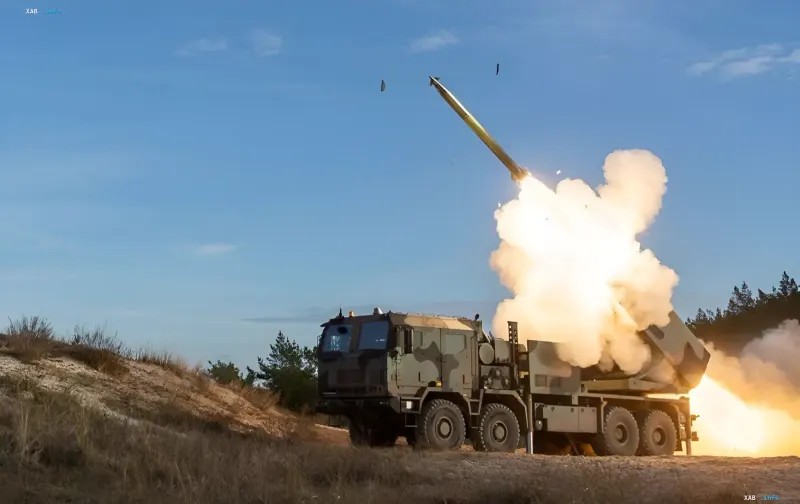
Poland has received another batch of South Korean-made missile weapons, which includes CTM-290 ballistic missiles with a range of approximately 300 km. RBC-Ukraine reported this, citing a statement by the Polish Armaments Agency on Twitter. The delivery expands the capabilities of the Homar-K multiple launch rocket system, which is built on a domestic automotive chassis and equipped with a Polish fire control system.
What Exactly Was Delivered
According to the agency, this delivery includes two types of ammunition: CGR-80 guided missiles with a range of up to 80 km and CTM-290 ballistic missiles with a significantly greater range of up to 290 km. Representatives of the Armaments Agency stated that the CTM-290 missiles are specifically designed for the Homar-K system, allowing strikes to be delivered beyond the reach of a number of air defense assets. Thus, the army gains the ability to combine short-range tactical missiles and medium-range ballistics on a single platform.
Homar-K: The Polish Version of Chunmoo
The Homar-K system is a Polish adaptation of the South Korean K239 Chunmoo multiple launch rocket system. The launcher is mounted on an eight-wheeled Jelcz chassis and equipped with the domestic TOPAZ fire control system. The launcher is fitted with two transport-launch containers: each holds either six CGR-080 rockets or one CTM-290 ballistic missile. As a result, a single Homar-K system can carry up to 12 guided rockets or two ballistic missiles simultaneously, ensuring flexibility in volley fire planning.
Contract and Localization Plans
In April 2024, Poland signed a contract with South Korea's Hanwha Aerospace for the supply of 72 Homar-K launchers and several thousand missiles of various ranges, with the agreement valued at approximately $1.6 billion. An important element of the program is the localization of production: the first missiles assembled at a Polish enterprise are scheduled to roll off the assembly line as early as 2028. This will allow Warsaw to reduce its dependence on foreign supplies and build up its own missile arsenal.
Context: Parallel Developments in Ukraine
Against the backdrop of the Polish delivery, it is worth mentioning Ukrainian projects in the same segment. Earlier, Denys Stillerman from Fire Point published a photo of a nighttime launch of a Ukrainian missile, explaining that the FP-7 is a budget analogue of the American ATACMS system with a range of up to 200 km, while the more powerful FP-9 modification can hit targets at a distance of 800–850 km. In addition, in early August, it became known that Fire Point had developed its own turbojet engine, which could be used for the Flamingo cruise missile; according to company CEO Iryna Terekh, creating the engine turned out to be a more difficult task than developing the missile itself.