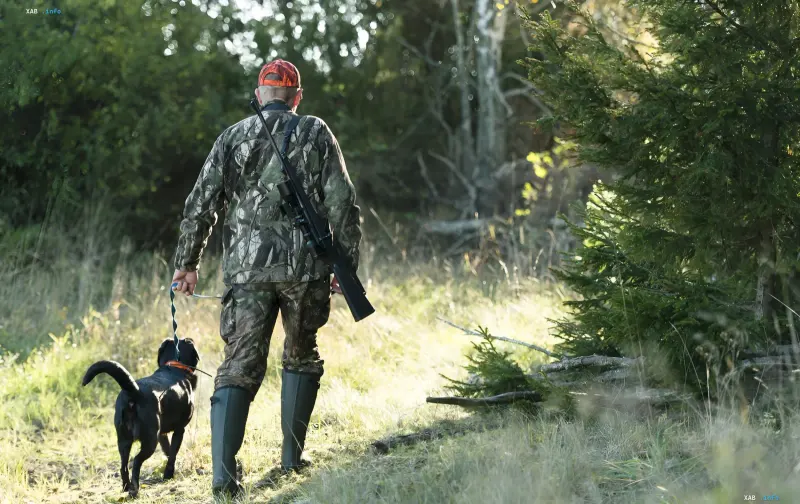
The Poltava Regional Council of Defense has decided to resume hunting activities in the region in 2026. Although a general ban on hunting during the period of martial law has been in effect since the start of Russia's full-scale invasion of Ukraine, regional authorities have opted for a targeted easing of restrictions. Hunters will be allowed to enter the hunting grounds for three months — from 1 October to 31 December 2026 inclusive — but only on weekends: Saturdays and Sundays. The decision was made within the Council of Defense's authority to regulate economic activity under martial law.
Season conditions and time frame
The key restriction of the new season is its strict tie to weekend days. Entering the hunting grounds on weekdays is prohibited without exception. As a result, over the entire three-month period, hunters effectively get around 26 days for hunting activities. The Regional Council of Defense's decision requires that information about the new rules be communicated to all users of hunting grounds of any form of ownership — both state and private. This means that every hunter planning a trip must be officially notified of the permitted dates and conditions.
Coordination and multi-level control
Entering the grounds is not an automatic right: each hunter is required to coordinate their activities in advance with three bodies. First, with the district military administrations; second, with the territorial units of the National Police; and third, with the Poltava zonal department of the Military Law Enforcement Service within its area of responsibility. This three-tier control mechanism indicates that the authorities view hunting during wartime as a potentially risky activity requiring coordination among civilian, police, and military structures. An uncoordinated entry into the grounds may result in administrative or criminal liability.
Background: from a full ban to targeted permits
The decision on a three-month autumn–winter season is not the first easing of restrictions. As early as December 2025, the Poltava Regional Council of Defense allowed certain groups of hunters to carry out activities to regulate the populations of red fox and wild boar, as reported by the media outlet Suspilne.Poltava. At that time, coordination with the police and military administrations was also required. Thus, the new 2026 rule represents an expansion of the earlier targeted permit: whereas in December 2025 the discussion concerned specific species and limited groups, the hunting season is now open to a wider circle of hunters and, presumably, to a broader list of species, although the specific list of permitted game is not clarified in the published data.
Legislative context and public debate
The regional decision fits within a broader legislative and public context. A bill, No. 15431, has been registered in the Verkhovna Rada, providing for a large-scale reform of the hunting industry, including its digitalization and new rules for the use of hunting grounds. The document has already drawn criticism from animal welfare organizations and ecologists, who are calling for its rejection due to a number of provisions they consider insufficient to protect wild animals. In parallel, a proposal to introduce an indefinite moratorium on hunting in Ukraine and to prevent the establishment of a state holiday called "Hunter's Day" was posted on the Cabinet of Ministers' website, but the corresponding petition did not gather the required number of votes. Thus, at the national level, the question of hunting during wartime remains a subject of active debate, and the Poltava region has effectively become the area where practice has outpaced federal legislation.
Contradictory data
The provided sources contain no direct discrepancies in dates or figures. However, there is a significant difference in the scope of the permits: in December 2025, the Council of Defense allowed hunting by "certain groups" solely to regulate the populations of two specific species (red fox and wild boar), whereas the 2026 decision is framed as a general three-month "weekend" season without an explicit limitation by species or hunter categories. The public materials do not clarify whether the new permit covers all game species or only those mentioned in the December decision. This creates uncertainty for the hunters themselves, who may need additional clarification from the district military administrations.