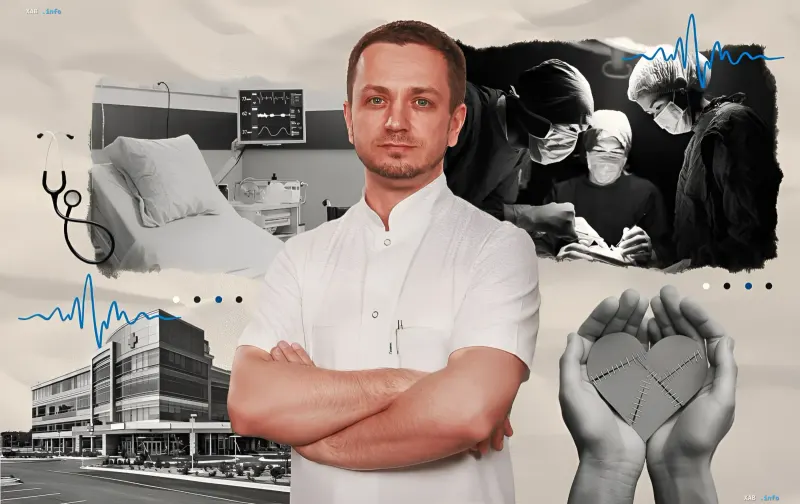
Organ transplantation in Ukraine has, over the past few years, ceased to be a set of isolated, almost heroic operations and has become more systematic. According to RBC-Ukraine's infographic, 327 transplants were performed in the country in the first half of the year. However, for patients awaiting new organs, the path to surgery remains long and unpredictable: some get a chance at transplantation within a few weeks, while others wait considerably longer. In an interview with RBC-Ukraine, cardiac surgeon and transplantologist at the Ministry of Health of Ukraine's Center of Cardiology and Cardiovascular Surgery, Serhiy Mokhatyi, explained how hearts are transplanted in Ukraine, who can become a donor, and why even a long wait does not guarantee a patient a new organ.
A Systemic Approach Instead of Isolated Operations
According to Mokhatyi, legislation in the field of transplantology is constantly changing, but there has been no positive impetus like the one seen in the past few years throughout Ukraine's entire independence. Previously, kidney and even heart transplants were performed on a one-off basis, without clearly defined rules: there was no "road map" for what to do when a donor was available or where to obtain organs when a patient in need was identified. The turning point came in 2018, when the foundational law regulating the organ transplantation process itself was adopted, although amendments to it are made continuously. Today, the criteria for organ retrieval, the procedure for directing a donor, and the circle of individuals performing transplants are all codified. A unified transplant-coordination center is in operation, tracking patients in need of transplantation and classifying them by severity of condition: the higher the urgency class, the earlier the patient receives an organ. When a donor appears, the center distributes organs as clinics join the list, and a donor registry is also maintained.
How the Waiting List Works and Whether It Can Be Bypassed
It is impossible to speed up the queue — the centers regulate the process strictly in accordance with the law. The transplant coordinator submits documents on the patient's condition and urgency class, with all examinations required to be completed before the patient is added to the waiting list. When a donor appears, compatibility is checked by blood type, weight, infectious status, and other parameters to rule out additional risks. An exception to the general logic is possible in only one case: if a patient, for example in the third urgency class for a heart transplant, deteriorates sharply and is connected to a cardiopulmonary bypass machine — then documents on the new form of treatment are submitted and the patient moves into the first urgency class.
How Long to Wait and How Many People Are Involved
In the transplantologist's assessment, the fastest waiting time for a heart is around three to four weeks, but it can be more than half a year. The chances of receiving an organ increase if the clinic has many agreements with other institutions where potential donors may be available. Behind the organization of a single transplant stands a large team: the center employs two transplant coordinators, six surgeons, and anesthesiologists, some of whom travel to retrieve the organ while the others go for implantation, since the same surgeon cannot perform both stages simultaneously. In total, around 20 people work simultaneously on a single transplanted organ.
War, Funding, and the Center's Real Experience
The transplantation program at the Ministry of Health's Center of Cardiology and Cardiovascular Surgery itself launched after the 2021 legislative changes, when the procedure for retrieving organs from donors was codified in the foundational law. Initially, a successful experimental operation was performed on pigs, but the full-scale war introduced changes: no transplants were carried out in 2022, and the program resumed roughly a year later. Since 2024, the state has been reimbursing clinics for such interventions at more than 2 million hryvnia, which simplified the implementation of operations, as few patients are able to pay for a transplant out of pocket. Over the past few years, nine of the center's patients have already received hearts.
Contradictory Data
The materials contain inconsistencies that should be honestly pointed out. First, the topic's announcement states that some patients wait for an organ "for years," whereas the cardiac surgeon, answering specifically about heart transplantation, names the upper limit of waiting as "more than half a year." The difference is explained by the fact that different parts of the material refer to organ transplantation in general and to the heart in particular, but to the reader this looks like a discrepancy in figures. Second, it is stated that the center's program has been in operation "for the past few years" and has already yielded nine transplants, while in 2022 no operations were performed due to the war — meaning the actual period of active work is shorter than the general phrasing might suggest. Both versions are presented as voiced by the source and the editorial team.
Debunking Myths About "Backyard" Transplants
Separately, Mokhatyi responded to claims circulating in society about allegedly possible transplants under "backyard conditions." In his words, this is practically impossible: the process involves a large number of people and complex equipment, and creating an illegal center whose existence no one would know about is unrealistic. He calls such statements baseless fakes, emphasizing that transplantation is a highly organized process, not an action that can be carried out outside the system.