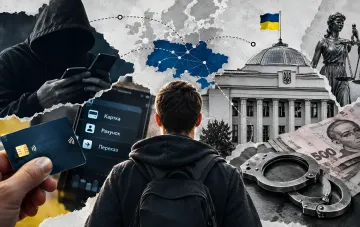
On September 16, 2026, the Verkhovna Rada of Ukraine adopted as a whole draft law No. 10190, which strengthens criminal liability for fraud committed through so-called "black" call centers, as well as for the unlawful collection and use of citizens' personal data. The document was supported by 313 members of parliament. This was reported by RBC-Ukraine, citing a statement from the parliament. The law was signed by President Volodymyr Zelenskyy on the same day and entered into force as a regulatory act.
New Articles of the Criminal Code
The adopted document supplements the Criminal Code of Ukraine with new articles establishing criminal liability for the unlawful collection, storage, and use of citizens' personal data with the aim of appropriating someone else's property. According to the explanatory note to the draft law, law enforcement agencies previously found it extremely difficult to prove such offenses, as the existing version of the code required confirmation of the final result — the actual theft of funds. The new version removes this limitation by introducing what is known as a formal offense composition.
Formal Composition: the Act Itself Is Sufficient
The key innovation of the law is the introduction of a formal offense composition. This means that to hold a person criminally liable, law enforcement no longer needs to prove that the fraudster actually appropriated someone else's money or property. It is enough to establish the fact of the unlawful act itself — for example, the organization of a call center, the systematic collection of personal data, or its transfer to third parties. As noted in the explanatory note, this approach is intended to more effectively counter systemic fraud schemes, including financial pyramids and mass phishing calls.
Context: the Problem of "Office Workers" and Black Call Centers
In Ukrainian criminal practice, the term "office workers" (ofisnyky) has become established — referring to people who work in illegal call centers and, following scripts, call citizens to lure them into revealing personal data of bank cards, SMS codes, or access to electronic wallets. According to expert estimates, the number of such schemes has grown manifold in recent years, with victims ranging from pensioners to young professionals. The adopted law, in essence, equates the activities of such call centers with organized criminal activity, allowing law enforcement agencies to detain not only the "leaders" of the schemes but also ordinary executors.
Related Draft Law on "Drops"
In parallel with the law on call centers, the Verkhovna Rada previously supported in principle a separate draft law aimed at so-called "drops" — individuals who transfer or sell their bank cards, settlement accounts, and SIM cards to fraudsters. This document provides for fines and imprisonment of up to eight years for those who knowingly provide their financial infrastructure for the commission of crimes. Experts note that the combination of both laws creates a more complete system for countering fraud chains: from data collection to the withdrawal of stolen funds.
Contradictory Data
In characterizing the adopted document, there is a slight discrepancy in emphasis between sources. RBC-Ukraine and the official statement of the Verkhovna Rada emphasize that the law introduces a formal offense composition for the unlawful collection and use of personal data. At the same time, the outlet Ukranews characterizes the innovation in its headline as "equating call centers with organized crime," which is a broader and more evaluative formulation. In fact, according to the explanatory note, the text of the law operates with the concept of a formal composition and does not directly introduce the qualification of an "organized group" under Article 255 of the Criminal Code. The difference, therefore, is editorial and interpretive in nature, but it may affect the perception of the scale of the reform by a broad audience.
The President's signing of the law on September 16, 2026, completes the legislative cycle and paves the way for the practical application of the new norms by law enforcement agencies. Analysts expect that in the coming months the prosecutor's office and the National Police will adapt their investigation methods to the new formal composition, which may lead to a sharp increase in the number of criminal proceedings related to the activities of "black" call centers.