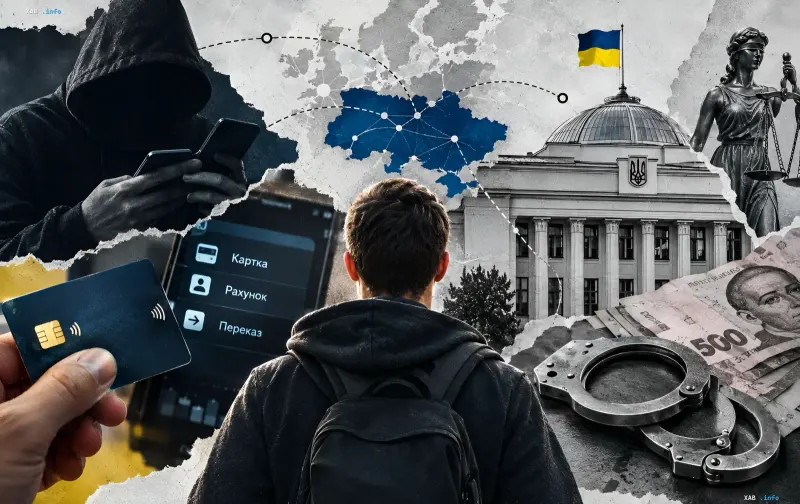
The Verkhovna Rada of Ukraine has accelerated the consideration of presidential draft law No. 16013, aimed at combating financial fraudsters and so-called drop schemes. The initiative is designed to block the channels for withdrawing and cashing out illegally obtained funds using other people's bank accounts and payment instruments. The document has already passed its first reading and is being prepared for final adoption.
Background and Accelerated Adoption of the Draft Law
The draft law was registered on September 2, 2026, as an urgent presidential initiative. On September 14, the Verkhovna Rada Committee on Law Enforcement reviewed the document and recommended adopting it as a basis. On September 15, parliament supported the draft law with 299 votes in the first reading and shortened the preparation period for the second reading under an expedited procedure. Currently, the document is at the stage of preparation for final consideration.
Essence of Innovations and Criminal Article 200¹
A key innovation of the draft law is the addition of a new Article 200¹ to the Criminal Code of Ukraine, which criminalizes the transfer, receipt, acquisition, storage, or provision of access to payment instruments, bank accounts, and electronic wallets. The legislator emphasizes the presence of a specific intent—the commission of a criminal offense or fraud. The mere fact of transferring a card to a relative without malicious intent will not become grounds for criminal prosecution, but the investigation will have to carefully prove the subjective side of the crime and the presence of intent.
Controversial Data
Active discussions have unfolded in the public space and media around the draft law. Some experts and citizens fear that ordinary citizens who simply share cards with loved ones or use third-party wallets for domestic purposes may fall under the new sanctions. At the same time, the legal community emphasizes that the wording of the draft law requires mandatory proof of criminal intent and the purpose of assisting fraudsters, which excludes punishment for bona fide account holders, although law enforcement practice after the adoption of the law may face significant difficulties in qualifying such cases.
Expert Assessments and Legal Consequences
Lawyers note that the draft law does not introduce established media terms like “drop” or “drop handler” into the legal field, but operates with clear forms of unlawful behavior and qualifying features, such as recurrence or the commission of a crime by an organized group. This requires law enforcement agencies to have a deep evidence base, excluding a superficial approach to investigating financial crimes associated with chains of transit payments.