American company Radia has unveiled the WindRunner, a unique cargo aircraft project designed to address one of the most pressing challenges in the modern aerospace industry — the transportation of large-scale space hardware. According to the publication XBT.com, the aircraft is intended to deliver rocket stages, large satellites, and reusable spacecraft directly to their destination without the need for disassembly. The project was showcased at the AFA Air, Space & Cyber Conference, confirming the idea's transition from a closed development stage to public discussion.
The Problem WindRunner Solves
The rapid increase in the size of space technology has pushed existing transport infrastructure beyond its comfortable limits: roads, ports, and standard cargo aircraft can no longer cope with the new dimensions. As a result, large systems must be disassembled at the factory and then transported by sea or land for weeks. This not only consumes time but also increases costs and, most importantly, raises the risk of damaging expensive equipment at every transfer stage. WindRunner is conceived as a direct answer to this logistical "bottleneck."
Design and Loading System
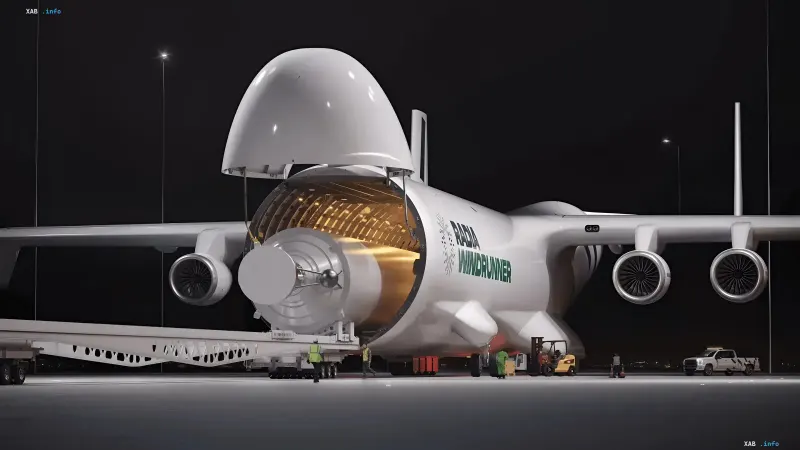
To accommodate large-scale objects, the aircraft will feature an opening nose section, a lower cargo deck, and a specialized loading system. Notably, as Radia's specialists emphasize, the aircraft is compatible with standard airfield equipment, eliminating the need to build complex infrastructure at each destination. According to the company, the cargo compartment's dimensions allow it to carry satellites twice as large as what current aviation can handle.
Role in Reusable Spaceflight
WindRunner is set to become a key link in servicing reusable rockets. If a rocket stage lands far from the main cosmodrome, the aircraft will be able to quickly retrieve it and return it to base for preparation for the next flight. This scheme shortens the turnaround cycle for equipment and reduces the cost of repeat launches, which is critical for commercial programs.
Positioning: A Complement, Not a Replacement
Radia explicitly states that WindRunner is not intended to fully replace existing military transport aircraft or ground logistics. The company positions it as a highly specialized transport for cargo that is too large for current aviation. In the long term, the project is meant to become a primary helper for commercial and government organizations in the rapid and safe transportation of large space hardware.
Contradictory Data
Available sources do not provide a single confirmed date for the start of serial production or the first flight of WindRunner: some materials describe it as a project in the design stage, while others present it as an aircraft already being showcased at industry conferences. Moreover, some publications use figurative language (for example, emphasizing a "bridge" between countries) that is not supported by the company's primary technical documents. The technical specifications — in particular, the claim of carrying satellites "twice as large" — are developer statements and have not yet been confirmed by independent expertise.
What Comes Next
For WindRunner, the key step will be the transition from concept and public presentations to prototype and certification. If the project is realized, it could change the economics of space logistics by shortening timelines and reducing risks when moving large-scale equipment. However, until confirmed data on production and testing emerges, the project remains at the stage of an ambitious but not yet flight-proven development.