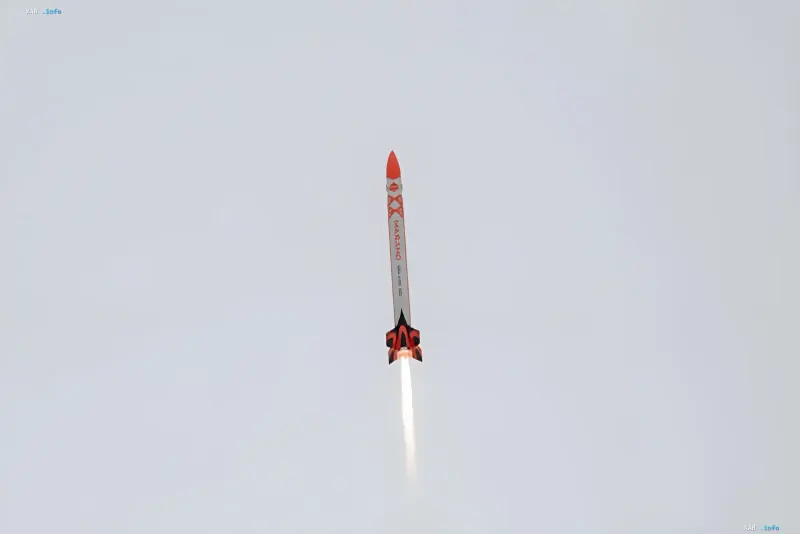
Taiwan's space agency (TASA) carried out the first successful launch of its independently developed sounding rocket, Maraho, on August 22, 2026. The vehicle lifted off at 07:10 local time from the Xuhai research rocket range in Pingtung County, becoming the first carrier created by the agency from scratch following the launch of its orbital-launch development program in 2023. Prior to this, the rocket had carried the provisional designation SR400. According to data published on TASA's official website, the launch proceeded nominally and allowed key onboard systems to be verified under real flight conditions.
Specifications and Flight Parameters
Maraho is a rocket 7.2 meters long and 0.4 meters in diameter, equipped with a hybrid propulsion system that uses 90-percent hydrogen peroxide and polypropylene as propellants. The engine ran for 18 seconds, providing a thrust of approximately 1,500 kilograms-force at liftoff. Within 49 seconds, the vehicle reached a maximum altitude of 8.1 kilometers, and its peak speed was 408 meters per second, corresponding to Mach 1.2 — meaning the rocket entered supersonic flight. The total flight duration was 432 seconds.
Main Objective of the Test — Continuous Telemetry
The central mission objective was to verify continuous communication between the rocket and the ground station, with telemetry transmitted throughout the entire flight. In parallel, TASA tested its own developments across several areas: the propulsion system, structure, avionics, communication and tracking systems, ground support, and the vehicle recovery system. The agency stated that the rocket successfully transmitted all required data to the ground before splashdown.
Splashdown and the Experience of a Young Team
In the final phase of flight, Maraho deployed its two-stage parachute system as planned and splashed down in the sea. Due to high waves and drift, the recovery team was unable to retrieve the vehicle from the water; however, as TASA emphasizes, this did not affect the test results. Agency head Wu Tsung-hsin noted that the mission allowed the young team to go through the full work cycle — from designing, manufacturing, and assembling the rocket to comprehensive testing and the launch itself — and to gain the experience needed to reduce risks in developing larger carriers.
Roadmap to Orbital Launch
The agency intends to use the relatively inexpensive launches of the Maraho-series vehicles to sequentially validate the technologies required for Taiwan's independent access to orbit. According to the published plan, a first-generation suborbital rocket, STV1, is scheduled for testing in 2029, a more advanced STV2 in 2031, and the first launch of an indigenous orbital carrier is targeted for 2034. The program's stated ultimate goal is to create the capability to independently deliver a payload of approximately 200 kilograms to low Earth orbit.