
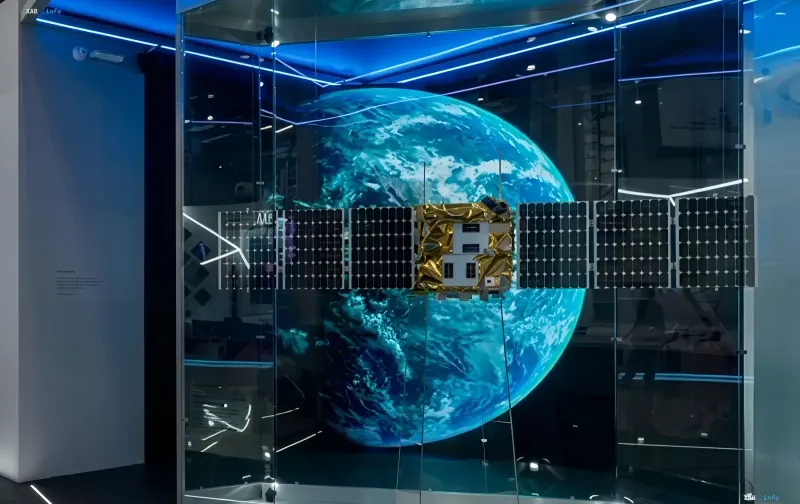
Amidst the prolonged conflict, the Ukrainian side is facing a new strategic threat from Russia. Ukrainian President's Advisor Serhiy "Flash" Beskrestnov revealed details of a large-scale program to deploy the Russian "Rassvet" satellite constellation in his Facebook account. According to him, this system is intended to become a full-fledged analogue of the American Starlink and provide the Russian army with reliable communication on the front lines, neutralizing Ukraine's advantage in the communications sector.
The mathematics of war: how many launches are needed for "Rassvet"
The expert provided specific calculations required to create a basic satellite constellation. According to Beskrestnov, to fully deploy the "Rassvet" network, Russia needs to make between 12 and 15 launches of "Soyuz" launch vehicles. Each "Soyuz-2.1b" rocket is capable of placing about 20 satellites into orbit. Thus, we are talking about the creation of an orbital group numbering hundreds of units, which will radically change the appearance of the information field on the theater of military operations.
According to the advisor's statement, Russia has already begun the active phase of implementing this project. Satellite launches are being carried out from the "Plesetsk" cosmodrome, however, experts note that the infrastructure for such operations could be used at other sites, including Baikonur and Vostochny. This makes the task of containing the "Rassvet" program significantly more difficult.
Vulnerable points: strikes on Khrunichev and factories in Omsk
A key element in the chain of creating a satellite network is the production of components for launch vehicles. Beskrestnov drew attention to the Khrunichev State Research and Production Space Center (Khrunichev) in Samara, which produces "Soyuz" rockets. On the night of August 15, Ukrainian Defense Forces struck objects in Russia, and according to intelligence data, one of the likely targets could have been this very plant.
However, as the expert noted, destroying such a giant production facility requires colossal efforts. Rocket components can be stored at cosmodromes or be in transit, which allows Russia to continue launches even with partial damage to production capacities. In addition, there is a threat from the heavy "Angara-A5" rocket, produced in Omsk. It is launched rarely (once a year), but theoretically capable of placing up to 60 satellites into orbit in a single trip.
Accelerated deadlines and overtaking plans
Particularly alarming is the fact that Russia is deploying the "Rassvet" constellation at an accelerated pace, ahead of its own plans. This indicates that Moscow views satellite communications as a critically important element for continuing the war. A successful launch of such a network will allow Russian troops to obtain stable communication at any point on the front, making their actions more coordinated and difficult to counter.
Contradictory data
Although the President's Advisor is confident in the threat from "Rassvet", there are discrepancies in assessments of the readiness of the Russian system. On the one hand, Beskrestnov's statements indicate an active deployment phase and accelerated timelines. On the other hand, independent sources note that the full functionality of the "Rassvet" system may not be achieved as quickly as the Ukrainian side claims. In addition, it is unknown whether Russia has a sufficient number of ready "Angara-A5" rockets for mass satellite deployment.
Also, the question remains open as to what real damage was inflicted on the "Progress" plant as a result of the strikes on August 15. If the plant is seriously damaged, this could slow down the pace of satellite launches, giving Ukraine time to adapt to the new conditions.