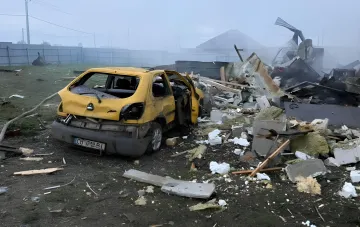
Scale of the night attack on Kyiv Oblast
During the night and morning of 9 September 2026, Russian forces struck as many as six districts of Kyiv Oblast, RBC-Ukraine reports, citing the State Emergency Service (SES). According to available data, the attacks were carried out using unmanned aerial vehicles and led to fires in populated areas. The specific list of the six affected districts is not fully disclosed in the provided editorial materials, so the publication does not name individual territories in order to avoid inaccuracies.
Fire at a food plant in Bila Tserkva
One of the consequences of the night strikes was a fire at a food-industry plant in Bila Tserkva: according to the SES, the blaze broke out after a drone strike. Rescuers arrived at the scene promptly and worked throughout the night to deal with the aftermath of the shelling; ultimately the fire was brought under control. Footage from the scene shows rescue crews in protective gear with yellow helmets directing hoses toward a smoke-filled building with corrugated metal walls. As the service notes, firefighting was significantly hampered by frequent air-raid alerts and the constant threat of repeated Russian strikes on the region, which forced crews to work with interruptions for warnings.
Strikes on Dnipro and rescuing people from the rubble
On the same night, Russia also struck Dnipro, where several fires broke out — including at a warehouse of building materials and in a private house. Rescuers pulled three people from the rubble of the damaged building; two of them were subsequently hospitalized. Thus, in Dnipro both material damage and casualties among civilians have been recorded.
Casualties at the 'Staryi Kozachyi' checkpoint
In parallel, drones attacked the international 'Staryi Kozachyi' crossing point on the border with Moldova in Odesa Oblast. Among the civilians in the vicinity there are fatalities and injuries, and the processing of citizens at this section of the border has been temporarily suspended. The incident underscores that the strikes affect not only industrial and residential facilities but also border infrastructure, impacting the movement of people.
Contradictory data
It is appropriate to highlight two inconsistencies here. First, there is a direct contradiction between the statements of the Russian side and the documented events: the Russian leader's spokesman Dmitry Peskov claims a supposed 'readiness for peace' with Ukraine and shifts responsibility for the 'further development of the situation' onto Kyiv's position, whereas on that same night and morning of 9 September new strikes with fires and casualties were delivered to Ukrainian regions. Second, the provided sources lack complete quantitative data: the exhaustive list of the six districts of Kyiv Oblast is not disclosed, and the exact number of fatalities and injuries at the 'Staryi Kozachyi' checkpoint and in Dnipro is not specified in the editorial materials — it is known only that there are fatalities and injured. The publication deliberately does not fill these gaps with its own estimates.
Takeaway for readers
The events of the night of 9 September 2026 demonstrate the wide geographical scope of the attacks — from Kyiv Oblast and Dnipro to the border section with Moldova in Odesa Oblast. The priority for rescue services remains containing the fires and extracting the injured under conditions of repeated alerts, while for civilians it is critically important to monitor official warnings and not approach damaged facilities.