August 15, 2026, Beijing. In the Zhongguancun Science Park, located in the Fengtai district, a restaurant named Yujian Weilai has opened. The name of the establishment, a play on words in Chinese, translates to "Meeting the Future." This is the first fully commercialized restaurant in the Chinese capital where the noodle-making process is entirely handed over to robotics.
Technology "from order to delivery"
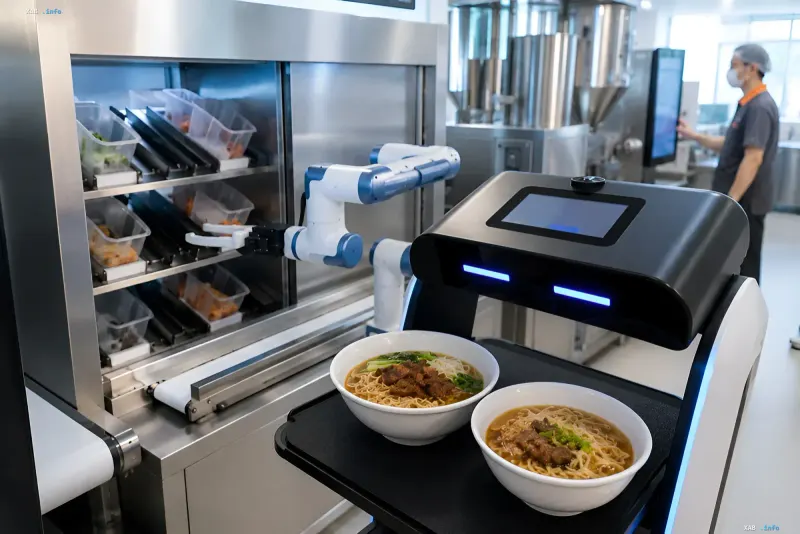
The service process at Yujian Weilai is built on the principle of seamless automation. The customer places an order by scanning a QR code installed at each table. Once the order is confirmed, a complex system is triggered: automated conveyors roll out and cook the noodles, add broth, meat toppings, and seasonings. The final stage involves a robotic arm that transfers the finished portion to a tray for a delivery robot. It is this robot that delivers the dish directly to the guest's table.
According to the developers, the entire cycle—from pressing the order button to serving the hot dish—takes just over 3 minutes. Currently, the menu features three types of noodles: with mushrooms and orange sauce (16 yuan), as well as two options with braised beef (19 yuan each). Prices are positioned as competitive, comparable to or even lower than those in traditional budget noodle shops in Beijing.
Beijing Yuli Technology Ecosystem
The uniqueness of the project lies in the fact that all equipment was developed in-house by Beijing Yuli Technology Company. General Manager Li Pengzhen stated that the company has created about 4,000 product items, including noodle-making machines, cooking devices, sauce makers, robotic manipulators, and dishwashers.
The key advantage of in-house development is control over connection protocols. Unlike traditional kitchens, where equipment from different manufacturers may not "communicate" with each other, at Yujian Weilai all machines are integrated into a single data system. This allows working parameters to be transformed into data for standardization: for example, if the system is set to dispense 250g of noodles, this weight will remain constant in every order, ensuring strict quality control.
Contradictory Data: "Full" Automation vs. Human Factor
Despite the loud positioning as the "first fully automated restaurant," actual operation has revealed nuances requiring clarification. During the trial launch on August 14, when the restaurant served more than 130 developer employees, it became obvious that the model does not yet mean the complete exclusion of human labor.
On the one hand, the company claims full automation of the cooking and serving process. On the other hand, one or two staff members are still required behind the scenes for the establishment to operate smoothly. Three critical processes remain outside the robots' responsibility: loading ingredients (flour, water, sauces), cleaning tables and collecting dishes, and serving beverages. Li Pengzhen acknowledged that automating these remaining processes is planned for the next stage of development; however, at the current moment (August 2026), humans remain an integral part of the ecosystem.
Safety and Prospects
Before the start of trial operations, the company completed all necessary procedures: obtaining business licenses, medical examinations for employees, disinfection, and pest control. Sauces and seasonings are prepared daily and processed on equipment on the same day, which excludes the use of preservatives.
The opening of Yujian Weilai demonstrates the expansion of robotics applications from industrial production to the service sector, directly related to daily life. The restaurant is expected to open to the general public at the end of August 2026, becoming a testbed for the future of the catering industry.