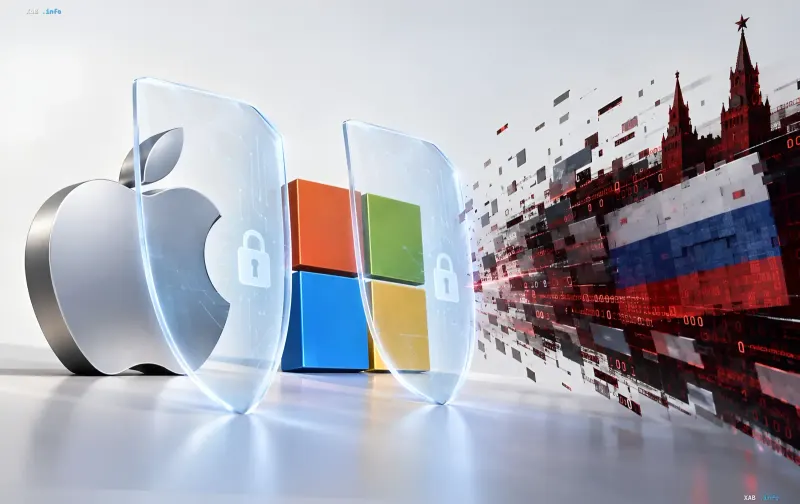
The Russian Federation has added American technology companies Apple Inc. and Microsoft Corp. to the registry of so-called 'information dissemination organizers.' This is reported by RBC-Ukraine, citing data from the Bloomberg media agency. According to available information, the inclusion of both companies in the list took place on October 2. Being placed in this registry automatically imposes a number of strict legal obligations on services provided by Russian legislation, primarily in the field of storing and transferring user personal data.
What Apple and Microsoft are specifically required to do
According to Russian law, companies included in the 'information dissemination organizers' registry are required to store the data of Russian users within the country and provide it to security agencies upon first request. This means that Apple and Microsoft must grant Russian special services access to information stored in their cloud services, email systems, and other digital products used by Russian citizens. The implementation of such requirements directly contradicts the privacy policies of both companies, which historically rely on the principle of minimal access to user data and information encryption.
Fines and the threat of blocking
Failure to comply with obligations arising from inclusion in the registry threatens companies with substantial monetary fines. In the event of a subsequent refusal to comply with the requirements, the Russian authorities are granted the right to completely restrict access to Apple and Microsoft services within the country. In practice, this could mean blocking the App Store, iCloud, Microsoft 365, Windows Update, and other key products for Russian users. A similar mechanism has already been applied to a number of foreign platforms that did not agree to data localization conditions.
Context: Who else is under pressure
The inclusion of Apple and Microsoft in the registry is not an isolated step. In January, Google and its Google Meet video conferencing service were added to the same list. Snapchat, FaceTime, Discord, Viber, WhatsApp, and Signal are in most cases available to users in Russia only through virtual private networks (VPN). Telegram founder Pavel Durov, wanted by the FSB, has become the subject of separate pressure on the messenger, further limiting its functionality in the country. Thus, the registry continues to expand, covering virtually all significant foreign digital platforms operating in Russia.
Mechanism of inclusion in the registry
Under current Russian laws, Roskomnadzor is authorized to include companies in the 'information dissemination organizers' list at the request of law enforcement agencies or by a court decision, and the consent of the organizations themselves is not required. Currently, several hundred companies are listed. This makes the registry one of the key instruments of administrative control over the digital space, allowing the state to consistently expand its sphere of influence over foreign technological services without the need for a separate legislative act for each specific company.
Part of a systemic campaign to control the internet
The inclusion of Apple and Microsoft in the registry is a continuation of a large-scale campaign to strengthen state control over the internet and foreign digital platforms, which accelerated significantly after the start of Russia's full-scale invasion of Ukraine in 2022. In recent years, Moscow has consistently tightened data localization requirements, introduced restrictions on messengers and social networks, and expanded the powers of regulators in the field of digital content. The inclusion of the largest American technology companies, whose products are used by millions of Russians, indicates that the process of subordinating the foreign digital sector to the Russian legal field continues and is not limited to any single industry or product line.