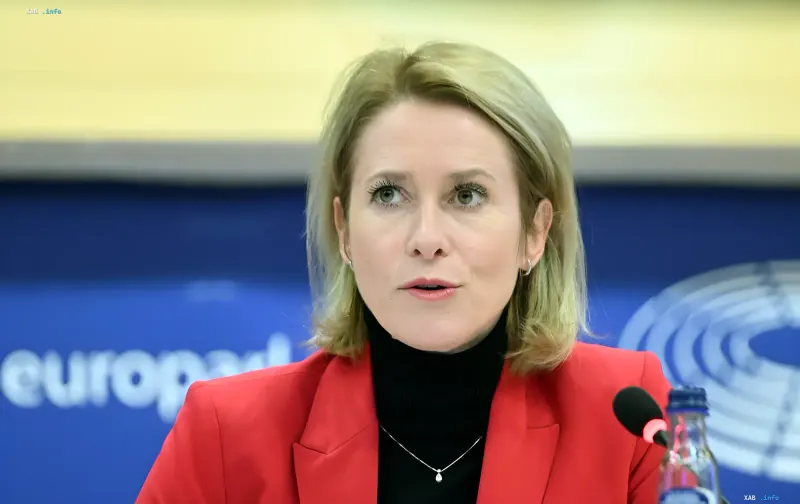
Moscow is once again outlining conditions that, according to the Kremlin, must be met before any negotiations to end the war in Ukraine can begin. This time, the focus has shifted to the question of who exactly will represent the European Union at the negotiating table. The Russian side has explicitly excluded EU foreign policy chief Kaja Kallas from the list of acceptable participants, stating that her presence would make dialogue impossible. This was reported by Reuters, citing a statement from Russian Foreign Ministry spokesperson Maria Zakharova, as relayed by RBC-Ukraine.
Zakharova: Kallas's participation will 'lead to breakdown'
According to Zakharova, Kallas's participation in any potential talks on Ukraine with Moscow would inevitably lead to their collapse. The Russian Foreign Ministry spokesperson called Kallas "completely unsuitable" for such a dialogue and listed a series of her previous statements, which the Russian ministry claims demonstrate the EU official's "anti-Russian sentiment." "If anyone in Brussels is interested in such a negotiator with Russia, it only clearly demonstrates to us what results they hope to achieve in a dialogue with us — the breakdown of any peace initiatives. I think this is something she (Kallas — Ed.) will do with distinction," Zakharova declared.
Brussels' response: Russia has no say
Kaja Kallas had previously established a firm position: Russia has no right to a say in who represents the EU at peace negotiations between Ukraine and Russia. She acknowledged being aware of Moscow's reluctance to see her among the negotiators but emphasized that she would act on behalf of all 27 EU member states. Thus, Brussels rejects the very logic of "pre-approving" the composition of a delegation with one of the parties to the conflict.
Ceasefire as a condition and skepticism toward 'security architecture'
The EU's top diplomat also formulated conditions that, in her view, must precede serious peace talks: Russia must agree to a ceasefire in Ukraine and make concessions. Kallas expressed particular skepticism toward Moscow's intention to discuss its own "European security architecture" within the framework of the negotiation process—Brussels does not consider it acceptable for one side to impose a security contour for the entire continent.
Dispute over negotiation venue: Moscow vs. European capitals
Parallel to this, a dispute has erupted over where and under what conditions contacts with the European side can take place. German Defense Minister Boris Pistorius stated that Europe should not rule out the possibility of negotiations with Russia in Moscow if they yield any results, and that it would be a mistake to reject Vladimir Putin's proposal to hold talks with Europeans in the Russian capital. Putin himself reportedly claimed that Russia had invited Europeans to come to Moscow to clarify their position on Ukraine and help shape the post-war security architecture on the continent. Meanwhile, Estonian Foreign Minister Margus Tsahkna spoke out against Putin inviting European leaders to Moscow: according to him, if the Kremlin truly wants peace, it should start with agreeing to a ceasefire, and this is the question it needs to answer first.
What this means for the negotiation track
A comparison of positions shows that the parties are currently talking about different things: Moscow insists on a "pre-filtering" of European negotiators and on discussing security according to its own scenario, while Brussels and a number of European capitals prioritize a ceasefire and the rejection of one side's veto right over the composition of a delegation. As long as these approaches remain incompatible, the question of who and where will talk to Russia effectively blocks the very start of the negotiation track and is turning into a separate political battle over the framework of future dialogue.