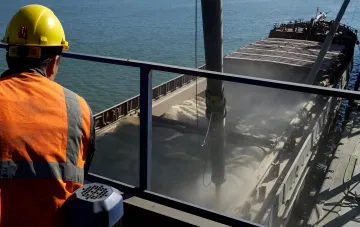
For the first time in post-war decades, Russia has utilized the Arctic sea route—the very route through which allied convoys delivered supplies to the Soviet Union during World War II—for grain exports. According to Reuters, cited by the Ukrainian outlet RBC, the decision was made amid the war in Ukraine and growing risks on traditional Baltic and Black Sea routes. Seeking to retain key grain buyers in the Middle East and Asia, Moscow turned its attention to northern capabilities after attempts to reorient supplies to the Baltic and subsidize rail transport from southern regions.
First batch and route to Casablanca
The speed of the launch is confirmed by concrete figures. The Murmansk Commercial Sea Port, together with trading company Demetra Holding, one of the largest in the country, has begun loading the first batch of grain totaling 3,400 tons from key agricultural regions. According to vessel trackers and market sources, about 28,000 tons of wheat are to be loaded in Murmansk onto a vessel bound for the Moroccan port of Casablanca. Thus, the Arctic corridor immediately enters into operation with distant foreign markets rather than remaining an experiment.
A port that remembers the convoys
Geography makes Murmansk particularly attractive under current conditions: the port is located nearly 2,000 km north of Moscow, near the border with Norway, and can be reached via neutral waters. This circumstance, along with the historical experience of the port being used by allied convoys in the 1940s, turns it into a viable alternative. «At a time when traditional export routes are facing restrictions, the Murmansk Commercial Sea Port is promptly opening an alternative path to foreign markets for Russian farmers,» the port said.
What is happening in other directions
The Arctic does not operate in a vacuum: it complements the restructuring of the entire logistics chain. In September, Baltic ports handled 1.2 million tons of grain, accounting for more than 60% of all maritime exports; to achieve this, Russian companies are massively converting terminals previously used for coal and fertilizer handling. Simultaneously, Russia has allowed grain trucks to leave Azov Sea ports for the first time since July, creating prerequisites for the resumption of food exports from the south. The combination of these steps points to a systemic diversification of routes rather than a one-off measure.
Ukrainian context: Relocation of customs checkpoints
Against the backdrop of these restructurings, Ukrainian logistics are also changing. Due to the constant threat of Russian attacks on grain trucks, Ukraine is considering moving customs control points to the territory of Poland and Slovakia; negotiations with these countries on this issue are already underway. Thus, the grain flow in the region is shifting both north and west simultaneously, forming a new export map in which the Arctic corridor becomes a key element.