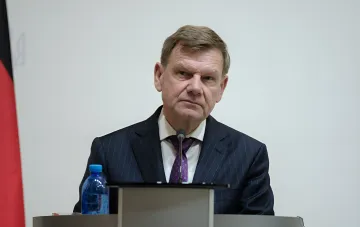
NATO Secretary General Mark Rutte, during a visit to Berlin on Monday, November 23, commented on reports in German media that Russia, according to intelligence, is preparing to launch a satellite equipped with a nuclear warhead in the coming weeks. Responding to questions about the publications, Rutte stated: "We will always ensure that we protect every inch of NATO territory, and that includes our security when it comes to the space element." Standing beside him, German Chancellor Friedrich Merz neither confirmed nor denied the information, but expressed concern, noting that reports of Russia’s plans to place nuclear weapons in space are "not new, but no less shocking" and show "what level of escalation Russia is evidently prepared to resort to."
What is known about the 'Sputnik-S' satellite
Plans by Moscow were reported by broadcasters WDR and NDR and the newspaper Sueddeutsche Zeitung, citing unnamed sources within the Bundeswehr and the German Federal Intelligence Service (BND). According to their data, it is a satellite named "Sputnik-S," which is said to have been fully assembled and ready for launch for several years, stored in the vicinity of Moscow. Once placed in orbit, the apparatus is estimated to become operational within a short time and could be used to jam or destroy critical communications and surveillance satellites. Intelligence regarding these plans was recently shared with several NATO countries, and the German government received a briefing: the Bundeswehr informed Defense Minister Boris Pistorius and other government officials.
Launch timelines and agency positions
According to the Bundeswehr's Space Command, the launch could take place as early as December 2026: if at the beginning of November intelligence warned of a possible launch within 60 days, now, according to sources, it is a matter of mere weeks. The BND declined to comment on the information, and the Bundeswehr Space Command referred to general statements by Defense Minister Pistorius that threats in space are taken seriously. A German government spokesperson also did not confirm the data but noted that it is being taken "very seriously" and called for avoiding "excessive nervousness due to hypothetical threats."
Russia's reaction and international risk assessment
The Russian leader's spokesperson, Dmitry Peskov, stated that he had not seen the latest publications on this topic, adding that frequent reports citing "unknown sources" "should hardly be taken seriously." The head of the European Space Agency, Josef Aschbacher, commented to the Handelsblatt publication, calling the appearance of nuclear weapons in space the "worst nightmare scenario." Experts emphasize that after an armed satellite is placed in orbit, there will be virtually no effective countermeasures, and the consequences of a nuclear explosion in space could be massive: it is estimated that one such explosion could disable up to 10,000 satellites and leave people without GPS, satellite internet, and mobile communications.
Context: previous warnings and maneuvers in orbit
It is important to note that such warnings have been made before. As early as spring, the US stated there were plans by Russia to place a nuclear anti-satellite weapon in orbit, and US intelligence reported that Russia was working on a satellite capable of carrying nuclear weapons. Also, in October, the Russian military satellite "Kosmos-2612" performed a series of complex maneuvers in orbit, approaching the ICEYE-X36 satellite, which provides intelligence data to Ukraine. Against this backdrop, the new reports from German media and NATO's reaction indicate that the topic of placing nuclear capabilities in space remains one of the most acute points in the sphere of strategic stability.