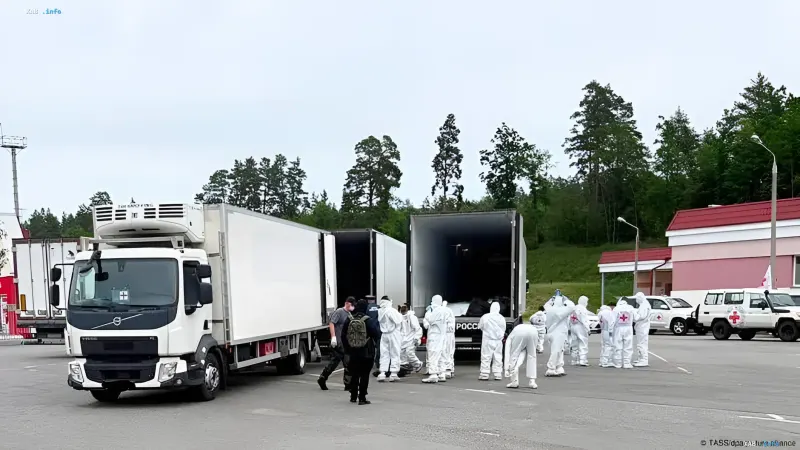
Russia and Ukraine have carried out another humanitarian exchange of the bodies of fallen servicemen. According to the Belarusian state agency BelTA, the procedure took place on November 26 at the border between Belarus and Ukraine. The Ukrainian side received the remains of 250 soldiers, while the Russian side received 22. The exchange took place following the resumption of trilateral negotiations mediated by the United States, giving the procedure both humanitarian and diplomatic significance.
Location and Procedure of Transfer
According to updates from Russian military correspondents, the transfer of bodies was organized in the Gomel Region on the Belarusian-Ukrainian border at the Novaya Guta checkpoint—the same location where previous exchanges took place. Personnel in protective suits worked at the site, and logistics were provided by refrigerated trucks. The Russian side claims that all bodies repatriated to its address belong to Ukrainian servicemen, as reported by the Ukrainian agency UNIAN.
Identification of the Deceased
Following the transfer of the remains, investigators and forensic medical experts in Ukraine will conduct necessary examinations to identify the deceased. This is a standard stage of such procedures: DNA analysis and identification through personal belongings allow information to be passed on to families and burial arrangements to be made. Similar work is being carried out on the Russian side regarding the returned remains.
Negotiation Context and Mediation
The exchange took place against the backdrop of resumed trilateral contacts mediated by the United States. As Kremlin spokesman Dmitry Peskov noted, preparations are concurrently underway for a prisoner exchange within the framework of agreements between Russia and Ukraine reached at a meeting in Abu Dhabi. Lists of servicemen for the exchange were compiled by the special services of both states, indicating a coordinated rather than improvised nature of the procedure.
Chronology of Previous Exchanges
The current transfer is not an isolated incident, but part of a series of humanitarian exchanges. On October 22, Kyiv received 252 bodies and Moscow 25; on September 17, the Ukrainian side received 252 bodies and the Russian side 23; in mid-August, Ukraine received 261 bodies from Russia and the Russian side received 24. Most of these procedures also took place on the Belarusian-Ukrainian border, including with the assistance of the International Committee of the Red Cross.
What's Next
Judging by the dynamics, the parties are maintaining a channel for regular body exchanges, which is important for the families of the fallen and for reducing humanitarian tension. It is expected that once identification is complete, lists will be published, while work on the prisoner exchange will continue in parallel. Further steps depend on the progress of trilateral negotiations and the readiness of intelligence services to agree on new lists.