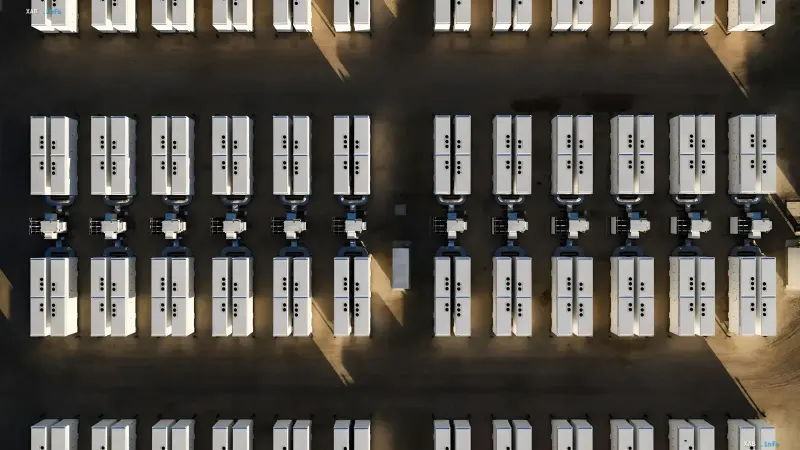
German energy corporation RWE has started construction of a large-scale Battery Energy Storage System (BESS) in the Italian city of Ragusa, Sicily. The facility, with a capacity of 62.5 MW and an energy storage capacity of 262.5 MWh, will be the company's first project of this type in the Italian market. The facility will consist of 42 standard containers filled with lithium-ion battery blocks and will be able to supply maximum power to the grid for four consecutive hours. According to RWE, this capacity is sufficient to cover the evening peak in electricity consumption for approximately 21,000 Italian households. The station is scheduled to become operational by the end of 2027.
Smoothing the 'Green' Imbalance
The primary function of the storage system is to compensate for the gap between the time of generation and the time of consumption. During peak production hours for solar and wind power plants, when the grid cannot absorb all the 'green' energy, the surplus will be used to charge the battery containers. During periods of high demand—especially in the evening hours when solar generation has ceased and wind generation may be unstable—the system will feed the stored electricity back into the grid. Thus, the facility turns the intermittent nature of renewables into a manageable and predictable flow of power for end users.
Grid Services and Infrastructure Connection
Beyond the basic storage function, the Ragusa station will perform several auxiliary tasks to support grid stability. These include fast reserve capacity and so-called grid-forming services, which help stabilize frequency and voltage in the local network segment. To fully integrate the storage facility, RWE is constructing the necessary infrastructure, including a high-voltage transformer that will connect the facility to the 150 kV main grid. This is a standard solution for facilities of this class, ensuring safe and efficient power transmission to the region's distribution substations.
Part of RWE's Global Storage Program
The Ragusa project is not an isolated initiative; it fits into RWE's large-scale program for developing energy storage infrastructure in Europe and beyond. Currently, the company operates battery installations with a total capacity of approximately 1.7 GW worldwide, with another 3 GW under construction. This makes RWE one of the largest BESS asset operators in the sector. The Italian market is strategically important for the company: Sicily has high solar generation potential, but the local grid has historically suffered from a lack of flexible balancing tools. This is why RWE's first project in Italy was implemented on the island specifically as a large-scale storage facility.
Context: Why Storage is Becoming Critical Infrastructure
The expansion of renewable energy sources in Europe's power system creates a structural deficit in inertia and flexibility, which were previously provided by traditional thermal and hydro-generation plants. Lithium-ion storage systems with capacities of tens and hundreds of megawatts fill this niche, providing millisecond responses to frequency deviations and hourly energy storage. For regions with a high share of solar generation, like Sicily, such facilities are shifting from 'optional' to 'systemically important.' The commissioning of the RWE station in Ragusa at the end of 2027 will be another confirmation that the BESS market in Italy is entering a phase of industrial scaling.