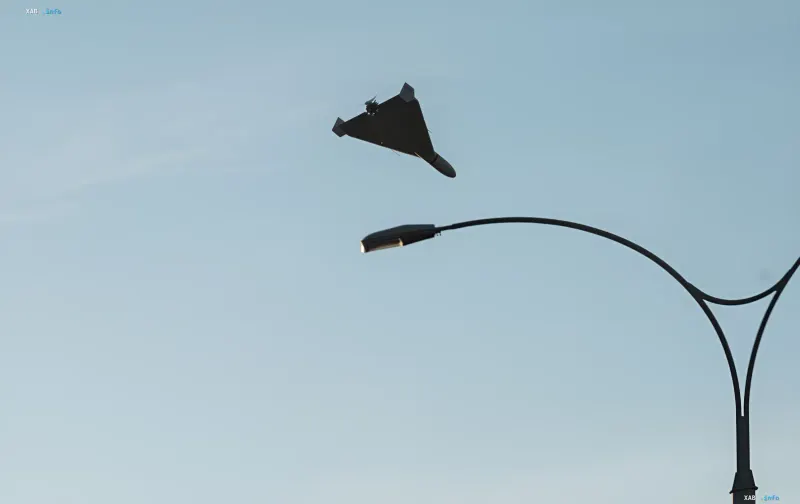
Tuesday, September 8, 2026, became yet another tense day for the airspace of Moldova. According to the country's Ministry of Defense, as cited by RBC-Ukraine, a “Shahed”-type strike drone entered the republic's sky — the same class of aircraft that Russia uses to attack Ukrainian territory. The incident was recorded during the day, and as a precautionary measure, authorities restricted flights in the central part of the country for several hours.
Timeline of the incursion
According to a statement by the Moldovan defense ministry, the drone crossed the state border from the Ukrainian side at approximately 16:20 local time in the area of the Slavyanoserbka settlement and was initially heading toward Bender. The aircraft was under observation by the National Army's air control systems. By 16:32, the drone, according to the ministry, was moving in the direction of the capital — Chișinău — and at 16:36 it was detected near the Bălnești settlement. Thus, the trajectory passed through a significant portion of the republic's territory.
Authorities' response and airspace closure
For safety reasons, the central part of Moldova's airspace was temporarily closed to aviation at 16:30. The restrictions remained in effect until the drone left the country's borders: after that, as the ministry reported, the prohibitions were immediately lifted and civilian air traffic resumed. The Ministry of Defense added that, in cooperation with international partners, it continues to monitor the sky to ensure public safety.
Contradictory data
Here the accounts diverge. The official Moldovan wording, conveyed through RBC-Ukraine, emphasizes that the drone “left the country's borders” and that the restrictions were lifted afterward — that is, the focus is on the drone leaving Moldovan airspace. At the same time, a number of Ukrainian and regional media outlets (including 24tv and slovoidilo) describe a longer trajectory: according to their data, the “Shahed” flew transit through Moldova into Romanian airspace and then returned and crashed. Thus, one version records only the crossing of the Moldovan border and the aircraft's departure beyond it, while the other — an additional flight into Romanian airspace and a subsequent crash. Until a single official confirmation of the exact trajectory and crash site is obtained, both scenarios should be considered partially inconsistent.
Context: a series of incidents
The September 8 incursion is not isolated. Recently, during another Russian attack on Ukraine, an aerial object was detected in Moldovan airspace, flying through the Transnistria sector. On the night of August 27, following a massive strike on Ukrainian territory, five drones entered Moldova — notably, they crossed the border only after the attack had ended. Even earlier, on August 17, a Russian “Bandierol”-type drone penetrated the republic: an explosion occurred near the Talmaza settlement in the Ștefan Vodă district, and a fire broke out after the drone crashed. A separate incident involving an aircraft resembling a “Shahed” was also recorded in May 2026. The totality of these events forms a consistent picture of repeated drone incursions into Moldovan airspace against the backdrop of nearby hostilities.
Chișinău's position
Moldovan authorities consistently emphasize that the priority is the safety of citizens and the stability of the airspace: each time a suspicious object is detected, temporary flight-zone closures are promptly introduced, and the restrictions are lifted once the object departs. The ministry also states that it continues to monitor the sky jointly with international partners. Against the backdrop of a growing number of incidents, the question of protecting the republic's airspace and coordinating with neighboring states and security allies is coming to the forefront.