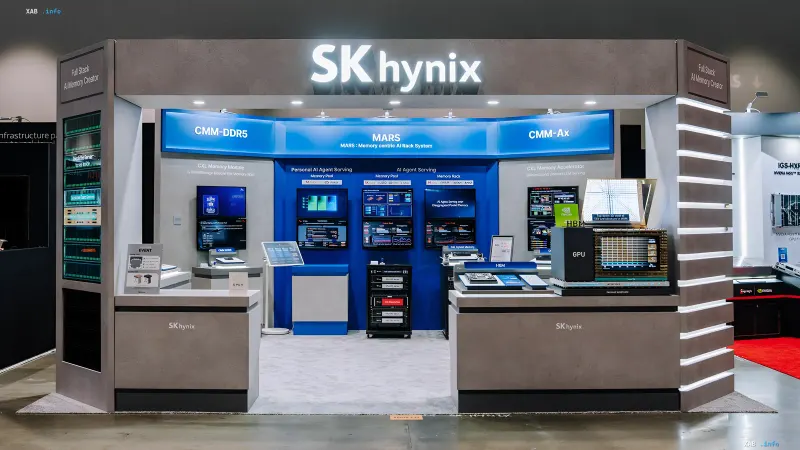
South Korean memory manufacturer SK hynix announced on October 16 that it showcased memory-centric server technologies at the OCP Global Summit in San Jose. The Open Compute Project event—a community developing open hardware for data centers—took place from October 12 to 15. At the core of the company's focus was the concept that memory ceases to be an auxiliary component and becomes the primary resource of a compute rack tailored for artificial intelligence workloads. Among the demonstrations were CMM-DDR5 modules, the MARS rack system, and CMM-Ax technology, which combines computing with memory.
CMM-DDR5: 256GB and up to 80 GB/s via CXL 3.2
The second-generation CMM-DDR5 module features a capacity of 256GB and operates on the CXL 3.2 interface (Compute Express Link—an open standard for connecting memory and accelerators). According to the company, the bandwidth of these modules reaches 80 GB/s, which is more than double the previous generation, while energy efficiency has improved by approximately 30%. The modules are designed for pooled memory, allowing multiple servers to utilize a shared capacity pool for flexible memory allocation across rack nodes.
MARS: A Rack Where Memory is the Central Resource
The company also introduced the MARS (Memory Centric AI Rack System) rack system, in which memory acts as the central resource of the rack, integrating partner technologies. Together with Naver Cloud, SK hynix demonstrated a concept of shared Key-Value cache (KV-cache)—intermediate data that accelerates text generation in large language models—for an AI agent environment, as well as shared vector embeddings for a service working with various data types. The booth also featured integration with GPUs and HBM, emphasizing a systemic rather than isolated architectural approach.
CMM-Ax: Computing Right Next to Memory
CMM-Ax technology brings computing closer to memory by reducing data movement. It was demonstrated on the task of serving large language models (LLM) with long contexts, where moving large volumes of data between memory and the accelerator traditionally becomes a bottleneck. Thus, SK hynix is building a lineup of solutions ranging from standalone CMM-DDR5 modules to the MARS rack system and the compute-memory CMM-Ax technology, covering various levels of the data center architecture.
Caveats: System Demonstrations, Not a Product
SK hynix emphasizes that these are system demonstrations rather than a widely available server platform. The announcement lacks independently verified benchmarks, pricing, or market release timelines. The stated characteristics—80 GB/s, 256GB, and a 30% energy efficiency boost—are provided by the company itself. The context reflects broader industry dynamics: memory manufacturers are accelerating the rollout of new solutions due to the surging demands of AI systems, making memory-centric architecture a key competitive battleground for the next generation of data centers.