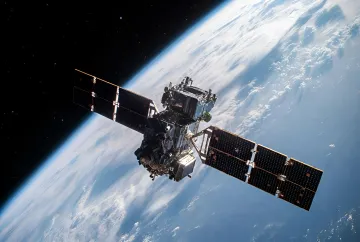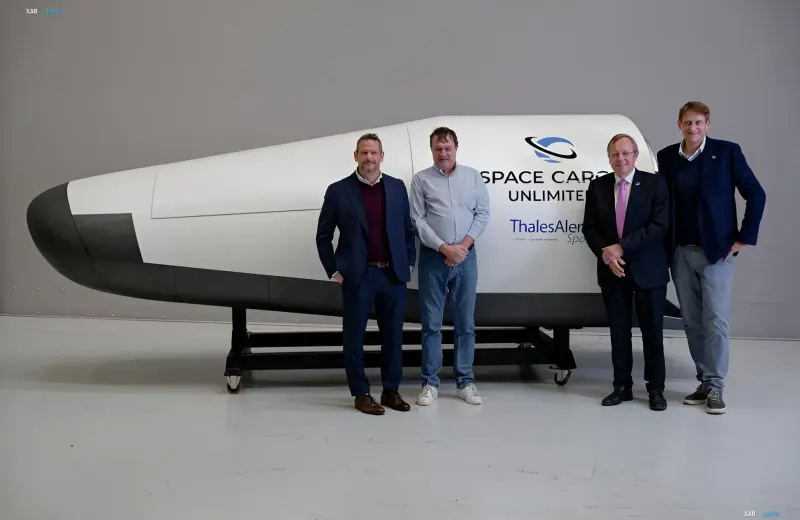
At the Space Tech Expo in Bremen, Germany, Space Cargo Unlimited presented the project of the REV1 reusable spacecraft, developed in partnership with Thales Alenia Space. The vehicle is designed for scientific experiments and materials manufacturing in microgravity conditions, followed by the return of cargo to Earth. At the presentation held on November 21, 2026, a mockup of REV1 was demonstrated to journalists and industry representatives — a streamlined white and black capsule bearing the logos of both developing companies.
Technical Specifications and Architecture
REV1 will feature a pressurized internal volume of 1,200 liters and a continuous power supply system of 2.5 kW. Depending on the specific task, the spacecraft will be able to stay in orbit for up to six months. The design includes two reusable modules: one is intended for returning cargo to Earth, while the other remains in space as a stationary platform. This dual-module architecture allows for the flexible combination of orbital production tasks and delivering results back to the planet.
BentoBox Platform and the Starfall Mission
At the core of the REV1 project is the BentoBox platform — Space Cargo Unlimited's system for conducting experiments and manufacturing materials directly in orbit. The company already plans to send BentoBox into space as part of a roughly one-ton mission aboard SpaceX's Starfall return vehicle. The launch of this mission is expected no earlier than 2028. In the future, Space Cargo Unlimited intends to use the BentoBox platform as part of REV1, ensuring technological continuity between the two generations of spacecraft.
Design Features and Onboard Systems
The REV1 design provides for the late loading of time-sensitive cargo, such as biological samples that must be delivered to orbit on an expedited schedule. The vehicle will also be equipped with systems to reduce vibrations and overloads during launch and return, real-time data transmission sensors, autonomous control, and onboard computing facilities. The combination of these systems will make it possible to monitor experiments directly during their time in orbit without the need for constant intervention by ground operators.
Implementation Timeline and Strategic Goals
The first flight of REV1 is scheduled for 2030. According to Space Cargo Unlimited, having its own return vehicle will give the company significantly more opportunities for conducting orbital experiments and delivering their results to customers on Earth. The partnership with Thales Alenia Space provides access to European expertise in space systems, while utilizing SpaceX's Starfall platform for preliminary BentoBox testing reduces technological risks prior to the launch of the full-scale REV1.