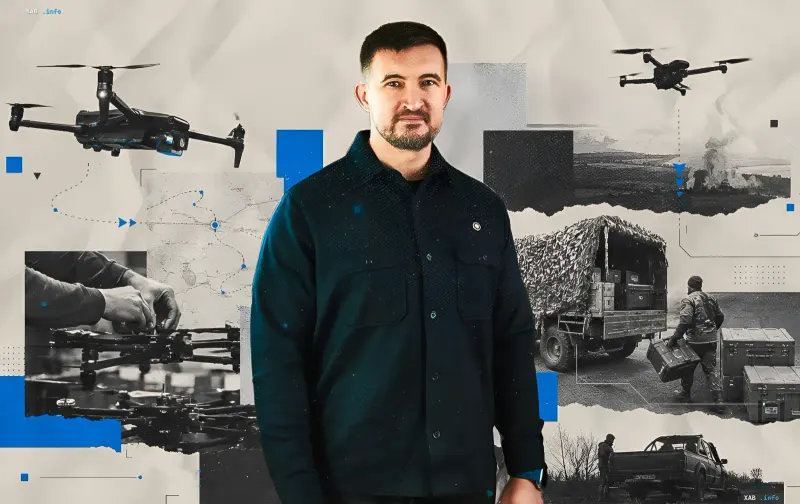
Yevhen Fedyrko, Executive Director of the Ukrainian Council of Weapon Manufacturers, described in an interview with RBC-Ukraine a systemic failure in the weapons supply chain: a significant portion of funds allocated by the European Union under the reparations credit for Ukrainian military equipment is effectively idle. The reason lies in the fact that the tender procedure, which the EU requires to be used exclusively for these funds, lacks basic documentation: tactical and technical specifications (TTS). According to Fedyrko, over the past six months, only four TTS for four types of equipment were prepared, and tenders were held for them. The rest of the European financing, which is gradually being transferred to accounts, has remained without a "point of application" because procurers simply do not know exactly what to include in the lots.
Tender Deadlock and the EU Reparations Credit
The core of the problem is the EU requirement to conduct procurement using reparations credit exclusively through tenders. Fedyrko notes that this is a "fairly interesting" condition, as EU member states did not conduct procurement via tenders during the First and Second World Wars. Nevertheless, the requirement is being fulfilled, and a joint structure of the Ministry of Defense and the General Staff was created for this purpose — so-called centers of competence. They were supposed to coordinate the collection of a massive knowledge and data base from the front lines, so that the Minister of Defense would have an analytical support made directly based on field data.
Centers of Competence: Structure Without a Leader
According to Fedyrko, the system of centers of competence was not fully launched: some centers existed only formally, without leaders, sufficient staffing, and established processes. Their goals, meaning, and tasks, in his assessment, were reviewed three or four times — changing both the purpose of creation and the main tasks, as well as the final product they were supposed to deliver; the last review of the concept, as he believes, occurred back in February. At a meeting on Saturday, he says, seven or eight such centers were already mentioned, although he was not given a precise answer about their number. Since the centers are effectively not created, no one has been pushing the TTS preparation process, and European money has ended up "locked" in a procedure not supported by documents.
The Math of Fines That Deters Manufacturers
Within the framework of the conducted tenders, winners were determined for 17 lots, however, in a number of cases, manufacturers refuse to sign contracts or fulfill obligations for individual lots, having miscalculated their own production capabilities. The situation is aggravated by the calendar: tenders were held at the end of summer, which means three months for procurement and another three for assembly, i.e., the final delivery date is already shifted to 2027, not counting the complex process of quality control during warehouse acceptance. To this are added the existing fines for delayed performance of military contracts: a penalty of 0.1% of the product cost for each day of delay and an additional fine of 7% if the delay exceeds 30 days. For a month, the penalty amounts to about 3%, and after 45 days, the total sanctions reach 11.5% — while the margin on a lot under tender competition conditions may be only 3–5%. "Even if they manage with the assembly, dealing with bureaucracy is impossible," Fedyrko summarizes.
The "Magical" Appearance of TTS on Saturday
Despite the described stagnation, Fedyrko notes a sharp shift: on Saturday morning, "almost magically," 80–85% of all missing TTS appeared. At the same time, in the morning on Saturday, the State Agency for Defense Procurement (SAPO) had not yet received them to prepare for tenders — they were promised to transfer the documents online as soon as possible. Similarly, in his words, on Saturday "magically," delays in signing some contracts for a separate nomenclature were also lifted. This allows for partially operational closure of the TTS problem, however, the question of how quickly the bureaucratic chain will translate the appeared documents into real deliveries remains open.
Brave1 as the Ukrainian DARPA
A separate line of conversation is the future of the Brave1 platform. Fedyrko admits that he initially believed that Brave1 would become this mechanism, but in the end, they decided to create a separate structure — centers of competence. The question of whether Brave1 will become the Ukrainian DARPA, i.e., a single center for the development and implementation of new military technologies, remains a subject of discussion and, in essence, depends on whether it will be possible to legally and organizationally complete those very unlaunched structures mentioned in the interview.
Contradictory Data
There are a number of inconsistencies in Fedyrko's statements that should be pointed out separately. Firstly, the number of centers of competence is not fixed: first, there was talk of six, then two more were added, and at the meeting on Saturday, seven or eight were already mentioned — the executive director of the council did not receive an exact figure. Secondly, a contradiction arises in the distribution of responsibility: on the one hand, he was explained that the centers of competence do not directly answer for TTS and that the General Staff is fully responsible for them; on the other hand, the plan assumed that it was through these centers that TTS were to be verified, signed, and transferred to SAPO for procurement. While the centers are not created, this chain is broken, and it is unclear which body ultimately "pushes" the preparation of specifications. Finally, the very fact of the "appearance" of 80–85% of TTS in one day and the simultaneous lifting of contract delays is described as a sharp and not fully explainable shift, indicating a possible concentration of decisions in a narrow time window without public disclosure of mechanisms.