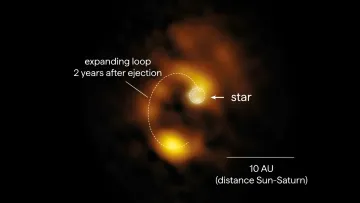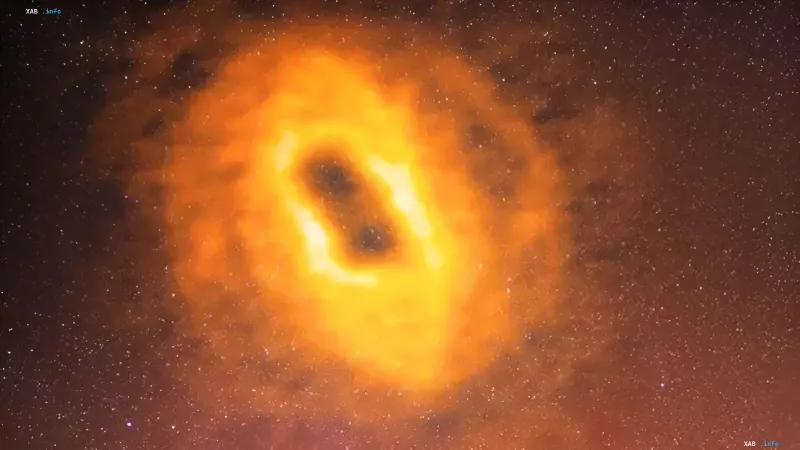
Astronomers have obtained the first directly observed evidence of the final thermonuclear flash of a dying star with a mass close to that of the Sun. Designated IRAS 06530-0213, the object is located approximately 12,000 light-years from Earth in the constellation Monoceros. The study was conducted using the ALMA radio telescope, which revealed a large shell of molecular gas surrounding a developing bipolar nebula with a characteristic two-lobed structure. According to the study's authors, the appearance of this shell preserves the trace of a so-called thermal pulse—a short-lived amplification of thermonuclear reactions in the star's shell, accompanied by the ejection of matter into interstellar space.
What the Telescopes Actually Saw
ALMA observations captured a gas shell about half a light-year in diameter. Based on the measured expansion velocity, astronomers estimate that the material was ejected approximately 6,500 years ago. Meanwhile, the age of the nascent bipolar nebula and the surrounding gaseous matter is estimated at less than 700 years—a mere blink of an eye on a stellar timescale. It is this exact moment—the shock wave from the final thermonuclear pulse and the beginning of planetary nebula formation around the stellar core—that has been successfully captured.
“Final Heartbeat”: The Physics of the Finale
The researchers poetically named the discovered trace the star’s “final heartbeat.” Such “heartbeats” occur after a star turns into a red giant: in the outer envelope, within the layers of hydrogen and helium, thermonuclear reactions periodically flare up, followed by the ejection of matter outward. After the last of these pulses, not enough matter remains around the star to sustain reactions, and most of the outer envelope dissipates into space. A planetary nebula begins to form from the outermost layers around the remaining stellar remnant—a white dwarf.
Chronology and the Role of a Companion
The observations made it possible to reconstruct the subsequent changes. Approximately 2,000 years after the flash, the rate of mass loss by the star remained relatively low, and then over the next thousand years, the ejection of matter sharply intensified. As a result, arc-like gas structures formed around the central nebula, which the authors attribute to the likely presence of a companion in the system: its orbital motion around the dying star, they believe, “muddies the waters” and distorts the shape of the outflow. At the same time, ALMA did not detect a compact dust disk near the central star, which is usually associated with the interaction of binary system components. The authors suggest that such a disk could have existed temporarily and disappeared after the formation of directed streams of matter—jets—as the star “ate” its partner.
Chemical Anomaly and Significance for Science
Another surprise is related to the chemical composition of the ejected gas: the researchers discovered an increased content of rare isotopes carbon-13, oxygen-17, and nitrogen-15. Their ratio does not match standard models of stellar nucleosynthesis, so this mechanism still requires refinement. Such processes have long been predicted by theoretical models, but the discovered structure represents the first direct evidence of the final such pulse in a star already transitioning to the final stage of evolution. Overall, the observational data allow researchers to compare theoretical models of the final stages of stellar evolution with how it looks in reality—at least in the case of a single dying star very similar to the Sun.