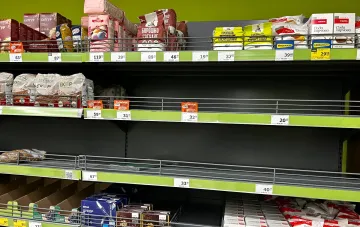
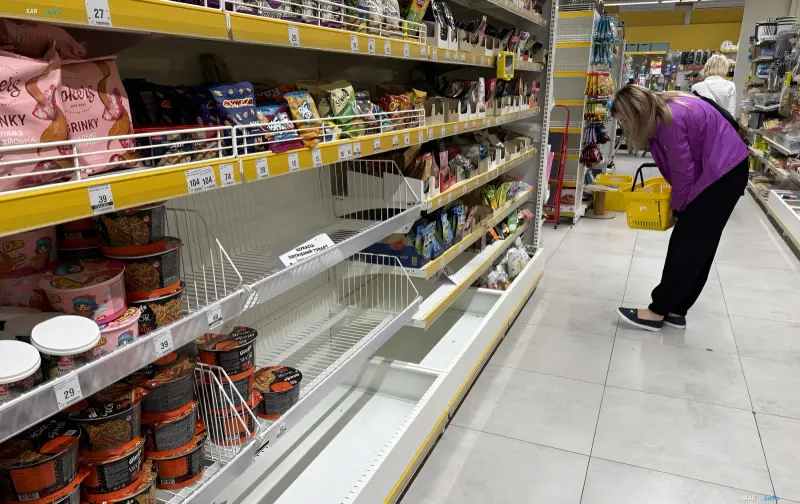
Russian strikes on food warehouses and logistics centers have caused supply disruptions of groceries in Kyiv and other Ukrainian cities. According to The Guardian, as cited by Ukrainian media, attacks on warehouses and supply chains near several cities have already led to shortages of certain products on store shelves. That said, sellers and shoppers note that the large-scale panic buying observed in 2022 has not yet occurred — the market is reacting to the situation in a measured way.
Scale of the strikes on logistics
Ukraine's Minister of Agrarian Policy and Food Taras Vysotsky stated that as a result of the recent attacks, the logistics centers of all major Ukrainian supermarket chains — in particular Novus, ATB, Silpo and Fora — were destroyed or significantly damaged. In his words, "this wave of strikes is the largest since the start of the full-scale invasion." Vysotsky emphasized that if in 2022 the adversary mainly targeted export-agricultural infrastructure, and in subsequent years destroyed the energy sector, then the attacks of August–September 2026 represent a "systemic attack on the internal life-support system of the civilian population," aimed at deliberately destroying the logistics that ensure food supply.
Shortages in stores and the absence of panic
Due to damaged infrastructure, certain products may become more expensive by several percent, and in some cases by up to 15%. Shortages of specific items are being recorded on the shelves, however retail chains and consumers are not observing a mass buying-up of stockpiles. This distinguishes the current situation from 2022, when acute panic buying was observed after the start of the full-scale invasion. Nevertheless, even moderate disruptions are already being felt in large cities, above all in Kyiv, where a significant share of distribution centers is concentrated.
Contradictory data
A significant discrepancy exists in assessments of the impact of the strikes on prices. Agrarian Policy Minister Taras Vysotsky estimates the possible rise in food prices at around 2.5% due to strikes on warehouse infrastructure. At the same time, business representatives allow for a considerably larger impact — up to 15%. Co-founder of Bureau of Wine Dmytro Krymskyi, whose company manages premium retail brands, including the Goodwine chain, cites a more moderate figure — around 5%. Thus, three different estimates are simultaneously heard in the public sphere: 2.5% according to the minister, around 5% according to business in the wine sector, and up to 15% as the upper bound allowed by entrepreneurs. The spread is explained by differing methodologies: the official assesses the average weighted impact on the food basket, while business factors into the price the cost of rebuilding vulnerable logistics.
Business adaptation: warehouses in Poland and underground facilities
According to Dmytro Krymskyi, the possible price increase will be linked less to a physical shortage of goods than to the need to restructure logistics to make supply chains less vulnerable to Russian attacks. The company is considering several options: relocating part of its warehouses to neighboring Poland, using underground facilities, and distributing stockpiles across several small sites. Krymskyi noted that business can no longer rely on a single large warehouse — it is precisely the concentration of stockpiles at one site that makes it critically vulnerable.
Timeline of attacks on the Bureau of Wine warehouse
One of the company's warehouses near Kyiv was attacked on 1 September 2026; as a result of the strike, goods worth approximately 4 million euros were destroyed. This is already the third strike on the company's warehouses since the start of the full-scale invasion: the first in 2022 destroyed products worth approximately 15 million euros, and the attack in July 2026 led to the loss of goods worth 1.5 million euros. Krymskyi emphasized that the new strike was "only a matter of time": the warehouse held about three thousand pallets, which could not be moved quickly, and due to constant air attacks workers could only work three to four hours a day, which further complicated the relocation of stockpiles. Recall that on 27 August the Russians carried out a massive strike on the logistics infrastructure of the Kyiv region, as a result of which the distribution centers of the "Fora," "Dom Ihruшек" (Toy House) and Comfy retail chains were damaged and destroyed.