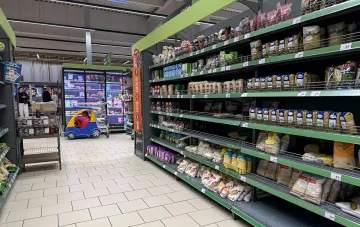
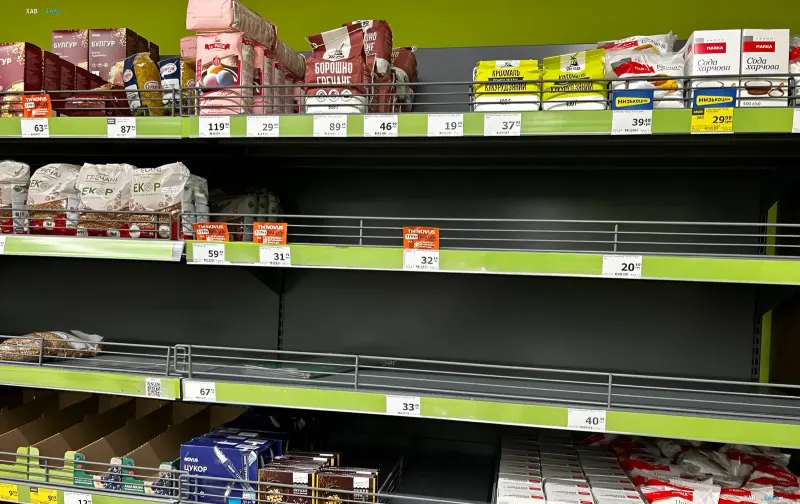
The Ministry of Agrarian Policy and Food of Ukraine commented on the wave of reports about the shortage of certain products on store shelves. According to Minister Taras Vysotskyi, as cited by RBC-Ukraine, the industry's balance indicators show that domestic production capacity is sufficient to meet the population's needs. In other words, the absence of a specific item in a specific store, in the ministry's assessment, is not equivalent to a general shortage of that product in the country. This difference is clearly illustrated by the shelves in store aisles, where certain product groups are temporarily underrepresented, even though the overall assortment and price tags are in place.
What the Agriculture Ministry Says About the Production Balance
The ministry's key argument is the balance assessment method: production volumes across major food groups exceed the needs of the domestic market. This means that the goods physically exist within the system — in warehouses, in transit, or in distribution centers — but not always at the moment when a shopper is standing in front of the shelf. Vysotskyi explicitly stated that the situation of “the product is not in this store” does not prove that “the product is not in the country,” and urged people not to confuse local product availability with macroeconomic shortage.
Logistics Named the Market's Main Challenge
The main cause of the temporary gaps on shelves, according to the Agriculture Ministry, is logistics. The traditional “producer — large warehouse — point of sale” chain has been disrupted or become unavailable in many directions, requiring a restructuring of routes. The new model, in the minister's assessment, is resource-intensive: it requires more transport and drivers, and delivery times are lengthened. It is precisely these factors, according to Vysotskyi, that can lead to the temporary absence or narrowing of the product range in retail, even when overall production is sufficient.
Restrictions in Chains and Regional Disruptions
The context is confirmed by retail practice. The “Auchan” chain previously introduced restrictions on the purchase of certain items, while the company denied rumors of a shortage and clarified that goods above the limit could be purchased separately at the wholesale purchase address. A similar picture was recorded in Dnipropetrovsk Oblast, where, due to heightened demand, certain products temporarily disappeared from shelves; the regional military administration assured that there was no general shortage, and that the delays were linked to artificial panic buying and the restructuring of logistics against the backdrop of the security situation.
Contradictory Data
It is appropriate here to note the discrepancy between the official assessment and consumer perception. On the one hand, the Agriculture Ministry, retailers, and regional authorities unanimously state that there is no systemic shortage and explain the gaps through logistics and panic demand. On the other hand, for the end consumer the reality looks different: on the shelves of some stores, product groups are underrepresented, and chains are forced to introduce limits, which is subjectively perceived as a shortage. Thus, formally the versions agree that “there is no shortage,” but they differ in their interpretation of the causes: the ministry sees the problem in the restructuring of supply chains, while some consumers and some retail outlets respond to the shortage in a specific store by restricting sales. The gap between the balance-based “sufficiency” and the shelf-based “availability” is the essence of the current contradiction.
What This Means for Consumers
The practical conclusion from the Agriculture Ministry's statements is that point-specific and temporary gaps on shelves should be viewed as a logistical, not a production, effect. While supply chains are being restructured to fit new security and demand conditions, local and short-term gaps in individual items and regions are possible. The ministry is effectively urging people not to extrapolate the situation in one store to the whole country and not to fuel panic demand, which, according to both retail and regional authorities, itself intensifies the visible shortage.