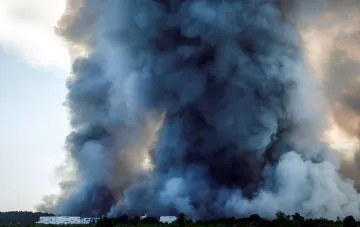
A series of strikes on the logistics centers of Russia's largest marketplace, Wildberries, has escalated from a local company issue into a systemic challenge for the entire country's economy. Attacks that previously focused on the energy sector have now hit e-commerce infrastructure, which has become an integral part of daily life for millions of Russians.
From Amazon to Vulnerability: The Scale of the Damage
Wildberries positioned itself as the Russian equivalent of Amazon, promising global-level competition. However, as noted by the Financial Times, the destruction of five warehouse complexes has turned the company into one of the most vulnerable elements of Russia's war economy. In 2025, the company's turnover reached 6.1 trillion rubles ($78 billion), and its network of pickup points covers even small settlements.
According to Russian media, the first four attacks destroyed approximately 444,000 square meters of warehouse space — about 8% of all Wildberries warehouses. Restoring these facilities could cost around 36 billion rubles. Meanwhile, Russian Forbes estimated losses from just the first strike on trains in Electrostal and Kotovsk at 150–235 billion rubles — a sum comparable to the company's net profit for the entire year of 2025.
Economic Consequences: From Sellers to the Budget
Alexander Kolyandr, Director of Eurasia Group, warns that the consequences will not be limited to lost goods. "The loss of goods will force thousands of traders to cease operations, leading to unpaid taxes and defaulted loans," he noted. In his view, the state could lose tens of billions of rubles in tax revenue from one of the largest taxpayers.
The situation was exacerbated by Wildberries changing its operating rules less than two weeks before the first strikes. The company recognized drone attacks as force majeure and exempted itself from the obligation to compensate sellers for damages. This sparked a wave of criticism from entrepreneurs, many of whom declared a total loss of inventory.
Compensation and Reality: The Gap Between Promises and Facts
In response to the criticism, Wildberries CEO Tatyana Kim announced an assistance program for 88,000 of the smallest sellers. Compensations will be calculated based on the assumption that the destroyed goods would have continued to sell at previous volumes. However, as reported by the independent outlet "Agentstvo," entrepreneurs in Telegram chats claim that payouts cover only a negligible fraction of the actual damage.
One seller recounted that after losing goods worth 1.5 million rubles, he received only 37,000 rubles from Wildberries. Such a gap between promises and reality is causing growing dissatisfaction among small businesses dependent on the platform.
Strategic Context: A New Phase of the Ukrainian Campaign
Attacks on Wildberries have become part of a broader Ukrainian campaign using long-range drones. Previously, the main targets were oil refineries, leading to fuel shortages and the need to increase imports. Now, the e-commerce sector is also under attack.
The Institute for the Study of War (ISW) previously stated that Ukraine attacked at least 10 Wildberries train compositions in a week. Analysts believe this creates new challenges for Russia regarding the defense of rear infrastructure and strikes at the interests of elites close to the Kremlin.
Thus, strikes on Wildberries warehouses have not only caused direct economic damage but also exposed systemic vulnerabilities in the Russian economy, which relies on large digital platforms and their logistics networks.