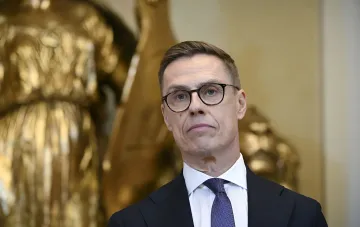
Finnish President Alexander Stubb stated in a fresh interview that he does not believe Russia would ever decide to attack NATO. Responding to a question about the German Ministry of Defense's warning that Vladimir Putin could be capable of attacking alliance territory by 2029, Stubb said plainly: "I don't believe Russia will ever want to attack the world's most powerful military alliance — NATO." At the same time, he emphasized that his words should not be taken as a call for complacency: "We need to prepare for the worst to prevent it."
Two pillars of confidence: intelligence and deterrence
Arguing his position, Stubb named two key factors. The first — the intelligence information held by Helsinki. The second — NATO's deterrence system, which he called "stronger than that of any other military power in the world." "It is based on conventional armed forces, missiles and nuclear weapons. No power in the world has any reason to test the resolve of this Alliance," the Finnish president emphasized. Thus, Stubb effectively stated that the combination of intelligence data and a multi-level deterrence system makes aggression against NATO strategically unprofitable for Moscow.
Information warfare as a tool of pressure
Separately, Stubb drew attention to the information loop surrounding the threat. In his words, the goal of Russia's "information war" is to sow fear in Europe, to make Europeans ask themselves whether Russia is attacking NATO and whether it will use nuclear weapons. The Finnish president thereby indicated that public discussions about the timing of a possible attack (including the German thesis of 2029) could work in Moscow's favor, heightening public anxiety without any real change in the military picture.
Mobilization as the only lever of escalation
Speaking of Russia's current capabilities for escalating the conflict, Stubb noted their limited nature. "At this point, Russia's capabilities for escalation are very limited. The only thing Russia can still use for escalation is mobilization," he stated. At the same time, in his assessment, an autumn mobilization in the Russian Federation threatens serious domestic political consequences for the Russian leadership, making this step extremely risky for Moscow.
Contradictory data
There is a discrepancy among the sources that carried Stubb's statement as to which publication the interview was given to. RBC-Ukraine and a number of Russian media outlets (Gazeta.ru, Rosbalt) cite an interview for the German newspaper Bild. At the same time, the Finnish public broadcaster Yle (yle.fi) indicates in its headline that the interview was for the Finnish newspaper HBL. The content of the quotes matches in both cases, however, the question of the original source of publication remains unresolved. Perhaps Stubb gave parallel comments to several publications, or one of the sources made an error in attribution.
Context: why the question is relevant right now
The statement came against the backdrop of ongoing debates in Europe about the timing and scenarios of a possible expansion of the conflict. The German Ministry of Defense's warning about Russia's potential capability to attack NATO territory by 2029 caused wide resonance in the public sphere. Stubb's position, as president of a country that joined the alliance in 2023 and is on the front line of the eastern flank, is perceived in Brussels and Berlin as an important signal: Helsinki does not consider the scenario of a direct attack the most likely, but at the same time insists on maintaining a high level of combat readiness and does not slow down the pace of strengthening defensive capabilities.